

Hans Raj College is the rare University of Delhi college whose standing rests on research as much as reputation. Its NIRF 2025 placement, third among all Indian colleges, is carried by a research score that outstrips either Delhi college ranked above it, not by perception. It draws students who want strong sciences and economics at a public-college fee, and it admits every one of them through CUET and the University of Delhi's central counselling.
Overview
Hans Raj College is a co-educational college of the University of Delhi, sited on Mahatma Hansraj Marg in Malka Ganj at the edge of the university's North Campus. The NIRF 2025 college list places it third nationally with an overall score of 81.75, immediately behind Hindu College and Miranda House.
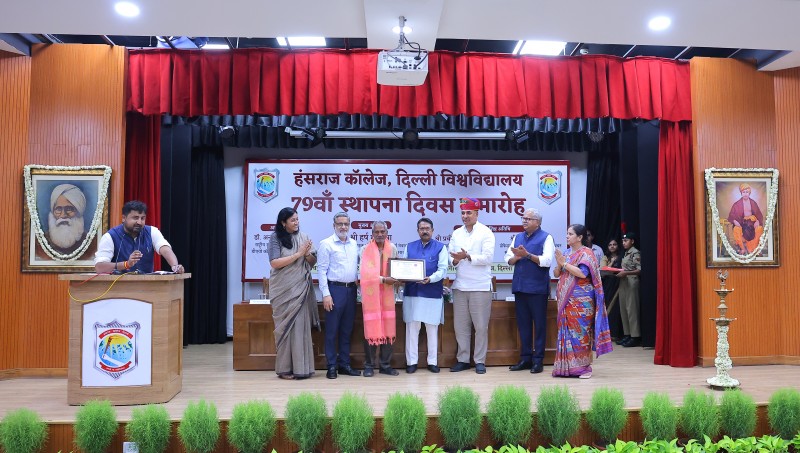
The college was founded by the D.A.V. College Managing Committee on 26th July 1948, in memory of Mahatma Hansraj, the Arya Samaj educationist who built the DAV school and college movement. That lineage still shapes the place: it is run by the DAV trust yet functions as a publicly funded University of Delhi college, so its degrees, admission route and fee heads follow university rules rather than a private operator's.
On quality signals, Hans Raj carries a NAAC accreditation of A++ with a CGPA of 3.71, and it is a Department of Biotechnology Star College that operates dedicated research centres under its Research@HRC banner. It began as a men's college and turned co-educational in 1978, and today it teaches science, commerce and humanities students side by side.
Courses & Fees
Hans Raj teaches a broad undergraduate spread, weighted toward the sciences but strong in economics and commerce. The undergraduate list runs from B.Sc (Hons) in Physics, Chemistry, Botany, Zoology, Mathematics, Computer Science, Electronics, Anthropology and Geology, through B.A. (Hons) in Economics, English, History, Hindi, Philosophy and Sanskrit, to B.Com (Hons) and the B.A. and B.Sc programme degrees. Postgraduate study is available in most sciences plus M.Com, M.A. and a Master of Operational Research.
What surprises most applicants is that tuition itself is tiny: the official fee structure sets annual tuition at just Rs 180 for most streams, and the rest of the bill is university and college development, facilities and one-time first-year heads. The table below is the total first-year fee for a General, SC, ST or OBC student.
| Programme group | Level | Entrance | First-year fee |
|---|---|---|---|
| B.A. (Hons) humanities | UG | CUET-UG | Rs 32,585 |
| B.A. (Hons) Economics and B.Com (Hons) | UG | CUET-UG | Rs 33,035 |
| B.Sc (Hons) sciences | UG | CUET-UG | Rs 35,945 |
| B.Sc (Hons) Computer Science | UG | CUET-UG | Rs 63,095 |
| M.A. | PG | CUET-PG | Rs 28,771 |
| M.Com | PG | CUET-PG | Rs 29,671 |
| M.Sc | PG | CUET-PG | Rs 28,971 |
Computer Science is the outlier because it carries far larger establishment and portal-and-network heads than any other stream. Second and later years drop the one-time components, so the recurring cost is lower than the first-year figure above.
Admissions
Admission to every undergraduate seat runs through CUET-UG and the University of Delhi's Common Seat Allocation System, and Hans Raj has no separate entrance test or management quota of its own. You appear for CUET-UG in the subjects that match your chosen course, then register on the university's CSAS portal, order your programme-and-college preferences, and wait for round-wise allocations against your CUET score.
One supernumerary route is specific to this college: as a DAV-run institution, Hans Raj operates a college ward quota for the wards of its own teaching and non-teaching staff, opened as a separate application each year (the 2026-2027 ward quota form is already live). The college also publishes each cycle's schedule and its bulletin of information on its own admissions page, though the binding steps, dates and eligibility live on the central DU admission portal, and postgraduate entry follows the parallel CUET-PG route. For every other applicant, your CUET score and your preference order decide the outcome, not a direct application to the college gate.
Cutoff
The seats that close highest at Hans Raj are the science honours and Economics, in line with its research-led, rank-three profile, so those are the ones to benchmark yourself against. Delhi University no longer publishes percentage cutoffs at all: under CSAS it releases category-wise CUET closing scores for each programme after every allocation round, and a course can shut at one score early and reopen at another as seats move between rounds.
The exact closing score for your category and course appears round by round on the university admission portal, which is the only place it is binding. Treat any fixed cutoff number you see on a third-party page as last year's history, not this year's bar.
Placements
Hans Raj runs an active placement cell, and its recruiter list leans hard toward consulting and finance rather than bulk IT hiring. The placement cell names Bain and Company, Kearney, LEK Consulting, Accenture Strategy, ZS Associates, DE Shaw, Deloitte, EY, KPMG and PwC among its recruiters, which is a roster you would expect at a commerce-and-economics stronghold rather than an engineering campus.
On volume, the placement cell counts more than 170 offers in its 2025-2026 on-campus season, and its 2024-2025 placement report records over 200 offers across finance, consulting, accounting and research roles.
| Metric | Value | Season |
|---|---|---|
| On-campus offers | 170+ | 2025-2026 |
| Total offers | 200+ | 2024-2025 |
The college publishes its full salary breakdown, average, median and highest package, on the placement page and in downloadable annual reports that run from the 2017-2018 season onward, so check those for the current season's exact figures.
Seat Matrix
The intake for each Hans Raj programme is fixed by the University of Delhi, not by the college, and it is released as part of the university's CSAS seat matrix before each admission cycle. That matrix breaks every course into category-wise seats, unreserved plus OBC-NCL, SC, ST, EWS and PwD, and adds the university's supernumerary quotas for single girl child, sports and extra-curricular achievers.
We could not find a standalone published seat total for Hans Raj that we can cite with confidence, so the reliable source is the current-year seat matrix on the DU admission portal and the college's own bulletin of information. Those documents carry the exact number of seats per programme and per category for the round you are applying in.
Rankings
Hans Raj College holds the third position among all colleges in India in the NIRF 2025 ranking, and the way it earns that rank is distinctive. Its research score is what carries it, while its graduation-outcomes score is the softest of its five parameters, a profile that says more about research depth than placement scale.
| NIRF 2025 parameter | Score |
|---|---|
| Overall | 81.75 |
| Teaching, Learning and Resources | 85.00 |
| Research and Professional Practice | 96.31 |
| Graduation Outcomes | 70.65 |
| Outreach and Inclusivity | 77.81 |
| Perception | 78.61 |
The research score of 96.31 is the single highest parameter on its scorecard and is unusual for an undergraduate-led college, which is consistent with its DBT Star College status and its active research centres.
Departments
The college runs two faculties, one for the sciences and one for arts and commerce, and the science side is the larger and more research-active. The science departments cover Physics, Chemistry, Botany, Zoology, Mathematics, Computer Science, Electronics, Anthropology and Geology, several of which supervise research and postgraduate work.
On the arts-and-commerce side sit Economics, Commerce, English, Hindi, History, Philosophy, Sanskrit and Physical Education. Beyond the teaching departments, the college runs research and innovation units under its Research@HRC programme, including a named research centre, and its biotechnology and life-science teaching is backed by its Department of Biotechnology Star College grant.
Facilities & Infrastructure
The Malka Ganj campus is a green North Campus site built around its science laboratories, which are the reason its research parameter reads the way it does. Departmental labs, a central library, and the research centres under Research@HRC give science students working space that goes beyond a standard undergraduate lab.
Beyond academics, the campus carries the usual North Campus support set: sports grounds and a gymnasium, an auditorium and seminar halls for the college's societies and fests, a canteen, and residential hostels. The college's own infrastructure pages describe a Wi-Fi-enabled campus with the labs and hostels as its anchor facilities.
Hostel
Hans Raj offers separate residential hostels for men and women, which matters at DU because most colleges cannot house every outstation student. The girls' hostel publishes its own prospectus and lists a dining hall, a reading room, a kitchen, indoor games and a gymnasium, along with a visitor's room and a guest room.
Security is built around round-the-clock staffing and CCTV coverage at the hostel gates, dining hall and grocery store, and the residential blocks are Wi-Fi enabled with free internet. Hostel seats are limited and allotted separately from your course admission, so treat accommodation as its own application with its own prospectus and deadlines.
Faculty
Hans Raj is run as a science-and-research college, and its faculty is organised to publish and supervise as much as to teach. The college holds Department of Biotechnology Star College status, awarded on the strength of a college's science teaching and mentoring, and it operates dedicated research centres under its Research@HRC programme where staff and students carry out funded work.
Several of the science departments supervise PhD and postgraduate research alongside their undergraduate classes, which is what lifts the college's research standing above that of a teaching-only college. For each teacher's qualifications, publications and areas of work, the departmental pages on the college website carry the individual profiles.
Notable Alumni
Hans Raj has one of Delhi University's more recognisable alumni rosters, and it spans cinema, business, sport and public life. Its best-known name is the actor Shah Rukh Khan, who read economics here, and the film-maker Anurag Kashyap, who took a zoology degree and graduated in 1993 before moving into cinema.
Beyond entertainment, the alumni list includes the union minister Kiren Rijiju, the industrialist and parliamentarian Naveen Jindal, the former TCS chief executive and Padma Bhushan recipient Subramanian Ramadorai, the Cambridge economist Partha Dasgupta, the former Solicitor General Gopal Subramaniam, the journalist Vinod Dua, and the Kargil-era air force pilot Gunjan Saxena. That range, from a Cannes-honoured director to a Cambridge professor to a war-zone pilot, is a fair picture of the kind of student the college has produced.
News & Articles
Hans Raj College posts its own notices, admission bulletins and results in the relevant sections of its website, and its downloadable placement reports run from the 2017-2018 season through 2024-2025. That archive is the honest record of how the college has done year on year, and it is more useful than any third-party news roundup.
For anything time-sensitive, an admission date, a fee revision or a seat-matrix change, the official website and the DU admission portal are the sources to trust, because those are the documents that actually bind.
College Compare
Among University of Delhi colleges, Hans Raj ranks third on the NIRF 2025 college list, sitting below Hindu College and Miranda House and above Kirori Mal College. On overall score the three Delhi leaders are close, so the choice between them is rarely about the headline number.
Where Hans Raj genuinely separates itself is research. On the same NIRF table its research and professional-practice score of 96.31 clears both Hindu College at 66.92 and Miranda House at 69.09 by a wide margin, so an applicant who wants a research-heavy, science-first environment has a real reason to prefer it, while someone optimising purely for perception or graduation outcomes might weigh the other two differently.
Contact & Location
Hans Raj College sits on Mahatma Hansraj Marg in Malka Ganj, within Delhi University's North Campus, and its office is reachable on the numbers and addresses below.
| Detail | Value |
|---|---|
| Address | Mahatma Hansraj Marg, Malkaganj, Delhi |
| Phone | +91-11-27667747, +91-11-27667458 |
| Placement cell | placementhansraj@hrc.du.ac.in |
| Website | hansrajcollege.ac.in |
The nearest Delhi Metro access is the Vishwavidyalaya station on the Yellow Line, a short distance from the college inside the North Campus cluster.
Verified
Approvals & Accreditation
Statutory approvals and accreditation grades from official bodies.
Aid
Scholarships
Decide
Compare with similar colleges
Voices
Student Reviews
Campus
Gallery
Questions
Frequently asked questions
References
Sources
- NIRF 2025 ranking – nirfindia.org
- Official website – hansrajcollege.ac.in
- co-educational in 1978 – en.wikipedia.org
At a glance
Quick facts
- Established
- 1948
- Affiliation
- University of Delhi
- NIRF 2025 (College)
- Rank #3NIRF· 2025-08-14
- NAAC
- A++, CGPA 3.71
- Website
- hansrajcollege.ac.in

Expertie Editorial Team
This page is researched and maintained by the Expertie editorial team, and checked against official sources.
Found something that looks wrong? Email us at editorial@expertie.com.
Last updated