

St. Stephen's College is the rare Delhi University college where a CUET score is not the only thing standing between an applicant and a seat. Under the Christian minority status it has carried since it was founded, half of its undergraduate places are filled through an interview the college holds itself, sitting on top of the CUET score, while the other half are allotted on CUET marks alone through the university's central system. It is the oldest college in Delhi and sits inside the top five of the government's most recent college ranking. Almost every question a Stephanian aspirant asks turns on that double identity: a constituent college of Delhi University that still runs its own admissions gate for the seats it reserves.
Overview
Founded on 1 February 1881 by the Cambridge Mission to Delhi together with the Society for the Propagation of the Gospel, St. Stephen's is the oldest college in the capital, and its first principal was Samuel Scott Allnutt, whose name one of the residence blocks still carries, per the college's history. It passed through affiliations with Calcutta University and then Punjab University before becoming one of the three original constituent colleges of the University of Delhi when the university was set up in 1922, as the college introduction records. The motto on its crest, Ad Dei Gloriam, reads "To the Glory of God", and the Christian, evangelical inspiration behind that founding is still written into how the college governs itself.
It is co-educational, not the women's college some searches assume, with men's and women's residences on the same campus. As a minority institution, St. Stephen's follows Delhi University's regulations in everything except the matters that flow from its constitutional minority status, which is the specific thing that lets it reserve seats and interview for them. The campus runs to 69 acres in the University Enclave off the North Campus, per its Wikipedia entry, and the college holds a NAAC A++ grade, the top band, recorded on its accreditation page. Teaching is spread across thirteen departments and seven centres, and the medium of instruction throughout is English.
Courses & Fees
St. Stephen's keeps a deliberately narrow, arts-and-sciences course list, and teaches all of it the same way: lectures paired with the tutorial system the college is known for, where small groups work through reading lists a tutor builds around the Delhi University syllabus. Since July 2025 every undergraduate programme carries a fourth year, following the university's move to the four-year framework, as the prospectus notes. The honours and multidisciplinary programmes on offer are below.
| Programme | Level | Entrance |
|---|---|---|
| B.A. (Hons) Economics, English, History, Philosophy, Sanskrit | Undergraduate | CUET (UG) |
| B.Sc. (Hons) Mathematics, Chemistry, Physics | Undergraduate | CUET (UG) |
| B.Sc. Physical Sciences (with Chemistry / with Computer Science) | Undergraduate | CUET (UG) |
| B.A. Programme (Multidisciplinary) | Undergraduate | CUET (UG) |
| M.A. English, History, Philosophy, Sanskrit | Postgraduate | DU PG admission |
| M.A./M.Sc. Mathematics, M.Sc. Physics | Postgraduate | DU PG admission |
On fees, St. Stephen's is a government-aided college, so its charges are the University's regulated heads rather than a private-college tariff. The bill splits into an academic fee, billed once a year at the start of the odd semester, and a college fee billed each semester, both paid online; general-category students settle it on the Delhi University portal after their allotment is verified. The college revises the exact amounts each session and publishes them in its fee-structure document, and because those figures move year to year and by category, the binding number is the one printed there for your programme rather than any single total quoted on a listing site. We could not retrieve the current rupee schedule from an official source, so treat the college's own fee-structure page as the authority.
Admissions
There is no separate St. Stephen's entrance test. Every applicant registers with the National Testing Agency, sits CUET (UG), and selects the University of Delhi, and from there the two halves of the college's intake diverge sharply, as its admission policy sets out. For unreserved seats, the college takes the CUET score alone as the basis and admits through Delhi University's Common Seat Allocation System, exactly like any other DU college. For the seats reserved under its minority status, it does what no CUET-only college does: it calls shortlisted Christian candidates to an interview and combines an 85% weightage on the CUET marks with a 15% weightage on that interview to decide the offer.
That split is not an in-house preference the college invented. It follows a Division Bench judgment of the Delhi High Court dated 12 September 2022 in WP(C) No. 8814/2022, reiterated in WP(C) No. 5426/2023, which the prospectus reproduces. Minority applicants therefore run a two-portal process: they register on the DU CSAS system and, separately, apply on the college's own admission portal, marking "Christian Minority" as their status so their data reaches the college, and they must produce a Baptism certificate and a church membership certificate to be considered. On the unreserved half, Delhi University's ordinary reservation categories apply through CSAS, because those seats are filled by the university rather than by the college.
Cutoff
A fixed cutoff is the wrong thing to look for at St. Stephen's, and for two different reasons depending on which pool you are in. The unreserved seats close at whatever CUET score the university's allocation lands on for each programme and category in a given round, a figure that only exists once that round has run, and because the college is heavily over-subscribed its stronger honours subjects tend to settle high. The minority seats have no CUET-only bar at all, since the offer is the blended CUET-and-interview result, so an applicant there is chasing a strong combined score rather than a marks threshold. Treat any "expected cutoff" circulating before the official CSAS round results as marketing, and watch the university's published allocation for your exact programme instead.
Placements
St. Stephen's is not an engineering or management college with a placement cell that publishes a median-package table, and it does not release one. Its own departmental pages describe outcomes in terms of where graduates go next rather than salaries: higher study in India and abroad, the civil services, law, journalism, academia, research and the creative fields. We could not find an official, college-wide placement report with verified figures, so rather than repeat an aggregator's number we cannot trace, we point you to the college and its departments for the destinations a specific subject leads to. For an outcome number that is actually verified, the closest one is the graduation-outcome parameter in the NIRF table further down, which tracks whether students finish and move on rather than any salary.
Seat Matrix
The most distinctive thing about how seats are divided at St. Stephen's is the minority reservation, which is unusually detailed. Half of the total undergraduate seats are set apart exclusively for Christian candidates, and that half is itself carved into denominational sub-shares, as the prospectus lays out. The rest of the intake is filled through Delhi University in the ordinary way.
| Category | Share of total UG seats |
|---|---|
| Christian minority (all Christian sub-shares together) | 50% |
| within the 50%: Church of North India (CNI) | 25% |
| within that CNI 25%: Diocese of Delhi (CNI-D) | 12.5% |
| within the 50%: other Christian denominations (C-OTH) | 16.5% |
| within the 50%: Christian Scheduled Tribes (CST), to the extent possible | 8.5% |
| Non-minority, filled through DU CSAS on CUET merit | 50% |
| Persons with Benchmark Disabilities (PwBD), horizontal | 5% (21 seats) |
Read the Christian block carefully, because the sub-shares nest rather than stack: CNI at 25%, C-OTH at 16.5% and CST at 8.5% are the three parts that add up to the reserved 50%, while the CNI-D figure of 12.5% is simply the Diocese of Delhi's half of the CNI slice, not a seventh category on top, as the prospectus sets it out. The exact number of seats per programme is notified by the college each cycle; the shares here are the standing structure those seats are distributed against. The 5% disability reservation is horizontal, meaning it is drawn across all the categories rather than added beside them.
Rankings
St. Stephen's is placed fifth among all colleges in India in the government's NIRF 2025 college ranking, with an overall score of 79.41, which settles a question some applicants still ask: the college does take part in NIRF, and ranks near the very top when it does. What the single rank hides is an uneven profile across the five parameters the framework scores.
| NIRF 2025 parameter | Score (out of 100) |
|---|---|
| Overall | 79.41 |
| Teaching, Learning and Resources (TLR) | 82.27 |
| Research and Professional Practice (RPC) | 45.96 |
| Graduation Outcomes (GO) | 91.23 |
| Outreach and Inclusivity (OI) | 74.90 |
| Perception | 93.15 |
Two things stand out. Its perception score of 93.15 and its graduation-outcome score of 91.23 are the real strengths, the marks of a place whose reputation and whose record of carrying students through and onward are both very high. The soft spot is research: its 45.96 on research and professional practice is barely half its own scores on perception and outcomes, the predictable gap for a college built around undergraduate teaching rather than doctoral research. That is the honest shape behind the rank, and it is worth weighing against what a specific department actually offers you.
Departments
St. Stephen's teaches through thirteen departments, and the spread sits squarely in the humanities and the pure sciences rather than professional or commerce streams. On the arts side are Economics, English, Hindi, History, Philosophy, Political Science, Sanskrit, and Urdu and Persian; the sciences are Chemistry, Computer Science, Mathematics and Physics; and Physical Education rounds out the list, per the department directory. Several run their own postgraduate programmes and long-standing departmental societies, and the tutorial that follows every lecture is organised at this departmental level, which is where the college's academic character is really set.
Facilities & Infrastructure
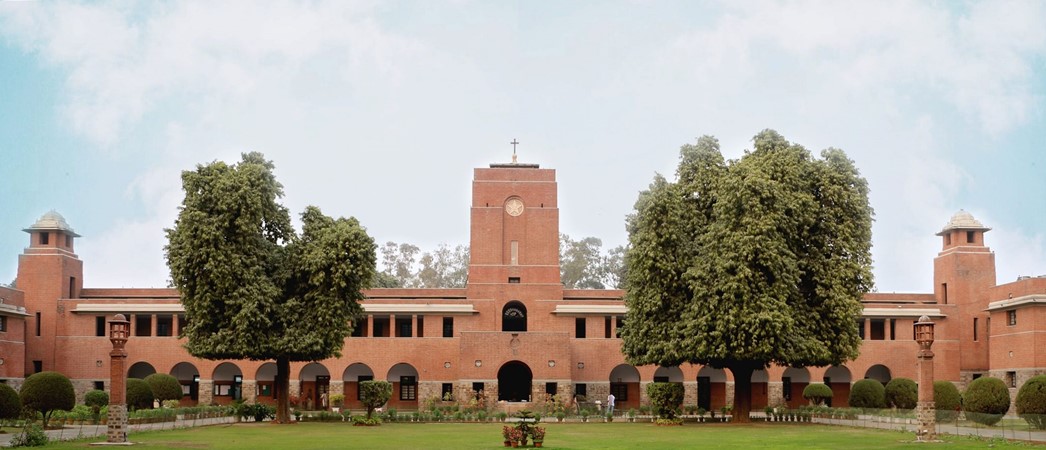
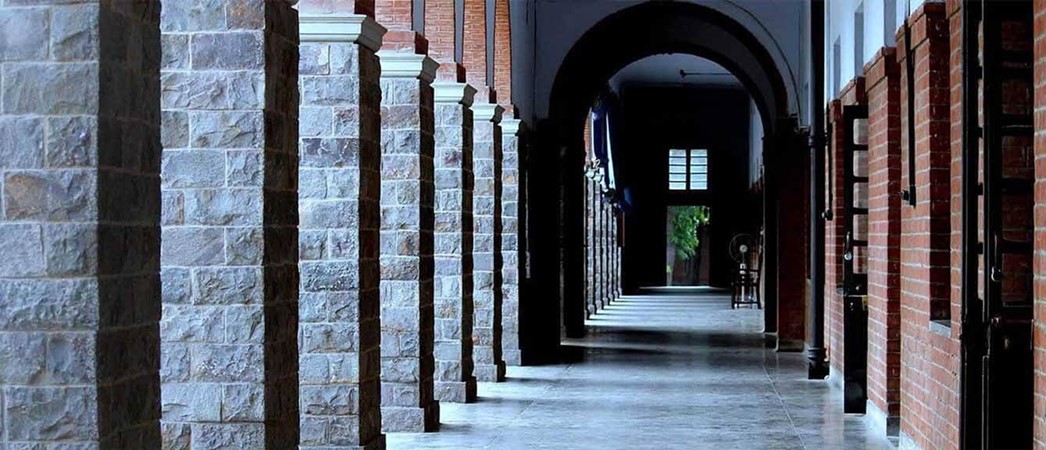
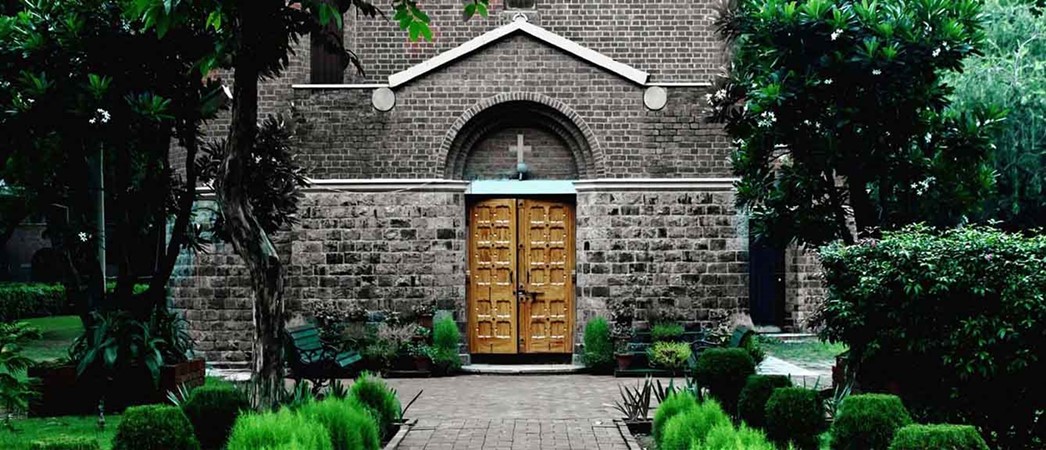
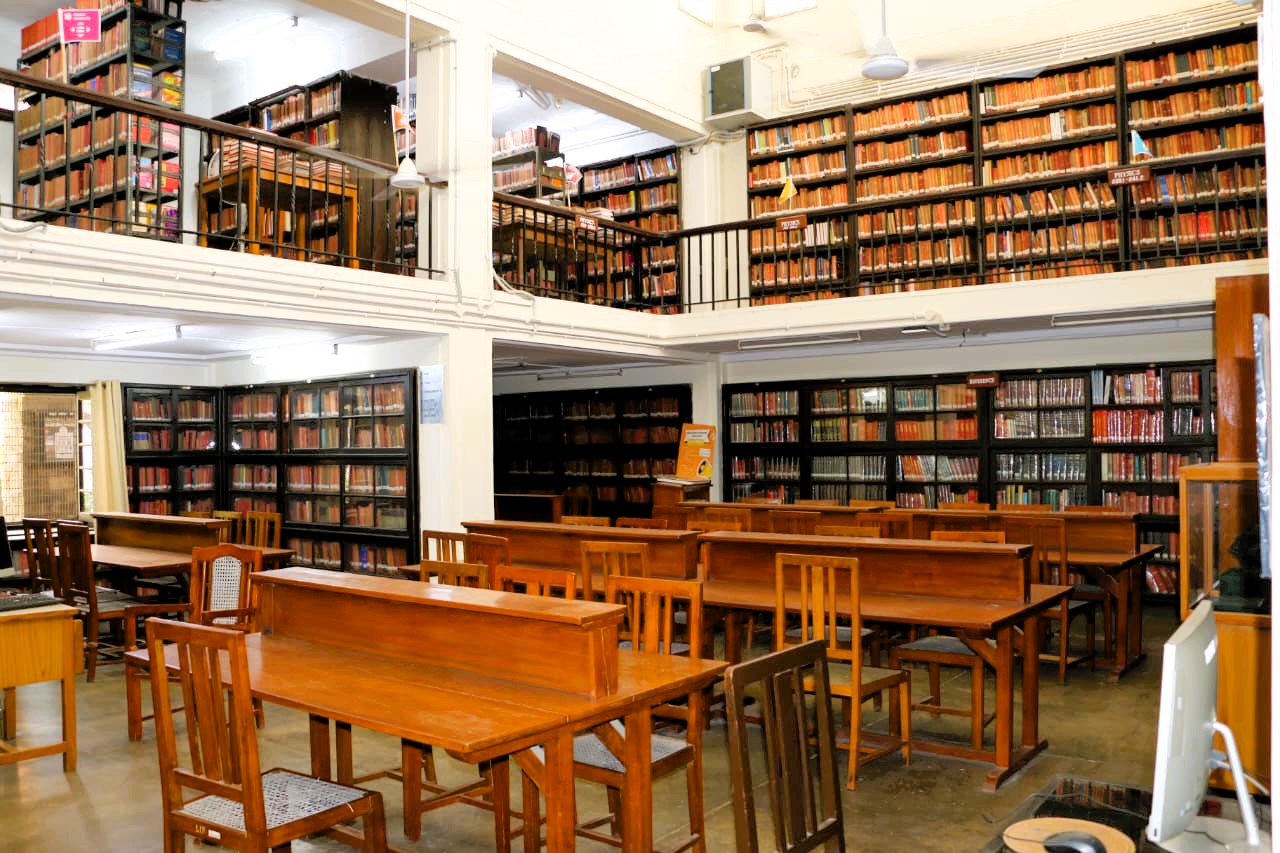
The college library is as old as the college, opened in 1881 and settled into its present building in 1941, and it is a genuine working collection rather than a showpiece: over one lakh books, more than 7000 rare books and around 4000 Persian titles, across a covered area of 993.10 square metres with 222 reading seats, as the library page records. Beyond the shelves it gives access to more than 126 databases and over 30,000 e-journals through library consortia, and it logs a couple of hundred users on an average day. Around the teaching buildings the campus carries the red-brick, cloistered architecture the college is photographed for, with a chapel at its heart, common rooms, a gymnasium, and sports grounds that include courts and a swimming pool.
Hostel
About a third of St. Stephen's students live on campus, in a residence system the college treats as central to its idea of itself rather than as overflow housing. There are six blocks, three for men (Allnutt North, Mukarji East and Mukarji West) and three for women (Allnutt South, Rudra North and Rudra South), each named after a former principal, together holding close to 200 men and 186 women, per the college's residence and introduction pages. The college was founded as a fully residential institution and still leans that way, but the rooms are limited and not everyone who wants one gets it, so applicants are told plainly to keep a safe off-campus arrangement ready as a fallback. Residence here comes bundled with a shared daily rhythm, the morning assemblies and the common dining hall among them, which is rather the point of it.
Faculty
Every programme at St. Stephen's is taught by the college's own faculty, and the model that defines their work is the tutorial: alongside lectures, teachers meet students in small groups against reading lists prepared for the specific course, which is a heavier per-student teaching load than a lecture-only college carries. Many departments also run research projects that pair faculty with junior members. The college publishes no single faculty headcount or student-teacher ratio, so for a specific subject the department's own staff page on the college website is the reliable source, and it is worth reading precisely because the tutorial load is set department by department.
Notable Alumni
Few Indian colleges have sent as many recognisable names into public life as St. Stephen's, across politics, letters, the bench, economics and cricket. A selection, drawn from the college's documented alumni, is below.
| Alumnus | Known for |
|---|---|
| Shashi Tharoor | Member of Parliament; former UN Under-Secretary-General |
| Kapil Sibal | Senior advocate; former Union Law and IT Minister |
| Montek Singh Ahluwalia | Economist; former Deputy Chairman of the Planning Commission |
| Mani Shankar Aiyar | Former Union Minister and diplomat |
| Ranjan Gogoi | Former Chief Justice of India |
| Naveen Patnaik | Former Chief Minister of Odisha |
| Amitav Ghosh | Novelist (The Shadow Lines, The Hungry Tide) |
| Khushwant Singh | Author and journalist |
| Ramachandra Guha | Historian and biographer |
| Kirti Azad | Test cricketer and World Cup winner |
| Kaushik Basu | Economist; former World Bank Chief Economist |
| Barkha Dutt | Journalist and author |
News & Articles
The college-level change most relevant to a current applicant is academic: from July 2025 St. Stephen's undergraduate programmes run over four years under Delhi University's revised framework, which adds a research-oriented final year, per its prospectus. The college also continues to submit data to and appear in the NIRF rankings, having returned after an earlier stretch of staying out of the exercise. Day-to-day notices, admission updates and event announcements are posted on the college's own website rather than syndicated, so the official notice board is the place to check dates and circulars during an admission cycle.
College Compare
Placed against Delhi University's other top colleges, the ones St. Stephen's is routinely ranked beside, its distinguishing feature is not a course or a building but the admission gate itself. Where those colleges fill every seat on CUET marks run through CSAS, St. Stephen's decides half of its intake through an interview it conducts under its minority status, which changes both what an applicant prepares for and who is eligible for which pool. On the academic profile it is a humanities-and-sciences college without commerce or professional streams, so a fair comparison is against colleges of a similar shape rather than a large multi-faculty institution. For most applicants the sharper comparison is programme by programme, since the same subject can be stronger elsewhere, so weigh the specific department, its faculty and its outcomes before ranking one name above another on a preference list.
Contact & Location
St. Stephen's occupies its red-brick, cloistered campus in the University Enclave off the North Campus, a short walk from the Vishwavidyalaya metro station. Its published contact details are below.
| Detail | Value |
|---|---|
| Address | St. Stephen's College, Sudhir Bose Marg, University Enclave, Delhi 110007 |
| Phone | +91-11-27667200 |
| ssc@ststephens.edu | |
| Website | ststephens.edu |
Verified
Approvals & Accreditation
Statutory approvals and accreditation grades from official bodies.
Aid
Scholarships
Decide
Compare with similar colleges
Voices
Student Reviews
Campus
Gallery

Questions
Frequently asked questions
References
Sources
- Official website – ststephens.edu
- Ad Dei Gloriam – en.wikipedia.org
- NIRF 2025 ranking – nirfindia.org
At a glance
Quick facts
- Established
- 1881
- Affiliation
- University of Delhi
- NIRF 2025 (College)
- Rank #5NIRF· 2025-08-14
- NAAC
- A++, CGPA 3.59
- Website
- ststephens.edu

Expertie Editorial Team
This page is researched and maintained by the Expertie editorial team, and checked against official sources.
Found something that looks wrong? Email us at editorial@expertie.com.
Last updated