

S.R.M. Institute Of Science & Technology, Chennai
SRM Institute of Science and Technology, known almost everywhere as SRMIST, is a private deemed-to-be university whose main campus sits at Kattankulathur, off the GST Road on the southern outskirts of Chennai, in Tamil Nadu's Chengalpattu district. It is one of the larger self-financed universities in south India, running engineering, medicine, management, science, pharmacy, law and architecture on one campus, and it should not be confused with the separately governed SRM University campuses in Andhra Pradesh, Sonipat and Sikkim. For an applicant the questions that matter are practical: how you get in, how far a given rank stretches across its many branches, and where the placement and fee numbers actually land.
Overview
SRMIST began in 1985 as SRM Engineering College and was granted deemed-university status in 2002 under Section 3 of the University Grants Commission Act, 1956, before taking its present name in 2017 (the phase in between is why older documents still call it "SRM University"). The main Kattankulathur campus spreads across roughly 250 acres about 35 km south of central Chennai, just off the Grand Southern Trunk Road (NH-32), and the institution runs additional campuses at Ramapuram and Vadapalani inside Chennai, one at Tiruchirappalli and one in the Delhi-NCR belt.
What sets SRMIST apart from a single-discipline college is breadth on one site. Engineering is the flagship by enrolment, but medicine, pharmacy, management, science, architecture and law all run on the same campus, and the Departments section below sets out the full list. Choosing SRMIST means choosing a large multi-faculty university rather than a boutique institute, and the trade-offs, big cohorts, branch-by-branch fees and how far a given rank stretches, follow from that scale.
Courses & Fees
SRMIST offers undergraduate, postgraduate and doctoral programmes across all its faculties. The heaviest enrolment is in the four-year B.Tech, offered in the mainstream branches (computer science, electronics and communication, electrical and electronics, mechanical, civil and biotechnology) and in a long list of specialisations such as artificial intelligence, data science, cybersecurity and IoT. Alongside it run MBBS and MD/MS in medicine, B.Pharm and Pharm.D in pharmacy, B.Arch in architecture, integrated and standalone law degrees, the MBA, and B.Sc, BCA, B.Com and BA streams under the College of Science and Humanities.
| Level | Representative programmes | Entrance exam SRMIST names |
|---|---|---|
| Undergraduate | B.Tech and integrated M.Tech | SRMJEEE |
| Undergraduate | MBBS, BDS | NEET, with MCC counselling |
| Undergraduate | B.Pharm, Pharm.D, B.Sc Nursing, allied health | SRMJEEH Health Science UG |
| Undergraduate | B.Arch | NATA |
| Undergraduate | BA LLB, B.Com LLB, BBA LLB, LLB (Hons) | SRMJEEL |
| Undergraduate | BBA, B.Sc, B.Com, BA, BCA, B.Des | None: qualifying-exam marks |
| Postgraduate | M.Tech | SRMJEEE |
| Postgraduate | MD, MS, MDS | NEET, with MCC counselling |
| Postgraduate | MBA | SRMJEEM plus a personal interview |
| Postgraduate | M.Pharm and the health-science masters | SRMJEEH Health Science PG |
| Postgraduate | M.Sc, M.Com, MCA, MA, LLM, MMS | None: qualifying-exam marks |
| Doctoral | Ph.D across all faculties | Department entrance plus interview |
On fees, SRMIST is self-financed, and B.Tech tuition is set branch by branch and campus by campus rather than as one flat figure, with computer-led specialisations costing more than the core branches; the binding number for any given programme is the one published on the university's official admissions pages. Rank moves the bill as well as the seat, and the bands are published rather than negotiated. The scholarship categories sheet carries a Founder's award that wipes both tuition and the hostel or transport charge for the first 100 SRMJEEE ranks, a B.Tech-only merit award that wipes tuition as far down as rank 500, and one entry worth flagging for anyone weighing a national exam: a Founder's award for a JEE Main rank inside the top 2000. Living costs are published separately and are covered in the hostel section below.
Admissions
Entry to SRMIST is programme-specific, so the exam you sit depends on what you want to read. For B.Tech the answer is a single test: SRMIST's engineering admission criteria set B.Tech against SRMJEEE (UG) and M.Tech against SRMJEEE (PG), and put nothing else beside either. A JEE Main score is not a second way in for a resident Indian applicant. Asked in as many words whether JEE Main or SAT scores are considered for the B.Tech degree programme, the SRMJEEE FAQs answer that SRMIST considers them for B.Tech international admission, and the same engineering page opens the regular-stream B.Tech application to resident Indians, sending NRI, PIO and OCI candidates to the international form instead. Where a JEE Main rank does count at Kattankulathur is money rather than entry: it earns the Founder's award named in the fees section above.
The test is sat in three phases across the year, which gives applicants a second and third window rather than a single make-or-break date, and campus is settled at counselling rather than on the application form. SRMIST's SRMJEEE page for the current cycle puts the mechanism plainly, saying a seat follows the SRMJEEE All India Rank and what is still available, and it names Kattankulathur beside Ramapuram, Vadapalani, Baburayanpettai and the northern campuses as places that one rank list feeds. A Kattankulathur seat is therefore an outcome of choice-filling, not something the exam confers by itself.
Every other faculty sits on a different paper, and the SRMIST admission brochure sets them out programme by programme. Medicine is the non-negotiable one: MBBS, BDS and the MD, MS and MDS seats are filled only on NEET eligibility and the counselling conducted by the MCC of DGHS, and no institution-level medical entrance can substitute for it. Architecture takes NATA. Pharmacy, nursing, physiotherapy and the allied-health degrees fall outside NEET and run instead on SRMIST's own SRMJEEH health-science paper, set separately at UG and PG level; the medicine and health sciences admission page calls the nursing paper SRMJEEN where the brochure calls it SRMJEEH, so check which name your application form uses. The integrated law degrees run on SRMJEEL followed by a personal interview, with a CLAT score earning direct consideration for that interview, and the MBA works the same way on SRMJEEM, where a CAT, XAT, MAT, GMAT, NMAT, CMAT or TANCET score buys the same shortcut to the interview. The science, commerce, humanities and BBA streams have no entrance exam at all: the science and humanities admission page says admission there is on the merit and marks obtained in the qualifying examination.
Applications are made online through the SRMIST admissions portal, and the sequence is the same each cycle: register, sit whichever of those papers your programme is listed against, then complete counselling and seat acceptance.
Cutoff
SRMIST does not publish a single "closing rank" the way a centralised counselling body does, because SRMJEEE is its own exam and seats are allotted on the SRMJEEE rank list category by category and branch by branch. In practice the pattern is consistent year to year: the computer-science family and its AI, data-science and related specialisations exhaust their seats at the sharpest ranks, the core engineering branches close more gently, and the Kattankulathur campus fills ahead of the newer or smaller campuses for the same branch.
Because the cut-offs move with each cycle's applicant pool and the seat matrix, treat any figure you see quoted online as indicative rather than fixed. The reliable read for a given year is the SRMJEEE rank-versus-branch allotment SRMIST releases during counselling, which is the only rank list its B.Tech seats are drawn from. We have not reproduced specific closing ranks here because SRMIST does not release them as an official, verifiable table, and inventing one would mislead more than it helps.
Placements
Placement outcomes at SRMIST are best read from its own NIRF submission rather than from headline "highest package" posters. For the four-year B.Tech cohort of 2023-24, the university reported 8,022 students graduating, 7,302 of them placed and a further 502 going on to higher studies, at a median salary of Rs 6,20,000 per year. That median is the number worth anchoring on: it says the typical B.Tech graduate, not the one outlier, left with roughly six lakh a year, and it has risen over the three years the submission covers.
Outcomes vary sharply by programme, and that spread is the caveat worth stating. The two-year MBA cohort of 2023-24 reported a much higher median of Rs 14,20,000 with 240 of 247 graduates placed, while three-year UG streams such as B.Sc and BCA sat far lower at a median near Rs 3,00,000. Engineering itself is not uniform either: the computing branches drive the recruiter footfall that lifts the whole campus average. So a realistic expectation depends heavily on the exact programme, and the median for your own branch is the figure to ask for.
Seat Matrix
SRMIST runs at genuine scale, which is why a strong SRMJEEE rank still leaves room across many branches. The sanctioned intake figures below come from the university's 2023-24 NIRF submissions and give a sense of how many seats sit behind each broad route.
| Route | Sanctioned intake, 2023-24 | Source submission |
|---|---|---|
| B.Tech, engineering (4-year UG) | 5,520 | NIRF Engineering |
| All 4-year UG programmes, university-wide | 11,790 | NIRF University |
| 3-year UG programmes (B.Sc, BCA, B.Com and similar) | 5,105 | NIRF University |
| 2-year PG programmes | 4,523 | NIRF University |
| MBBS (5-year UG) | 250 | NIRF Medical |
| MD/MS medical PG | 177 | NIRF Medical |
The category-wise split of these seats (SC, ST, OBC and management or NRI quota) is fixed each admission cycle and appears in the SRMIST counselling notification, not in a single standing table, so confirm the current-year allocation on the official admissions portal before you plan around it.
Rankings
In the National Institutional Ranking Framework 2025, SRMIST is placed 11th among Indian universities, a top-of-band position for a private deemed university that ranks it above most of its Chennai peers on that list. Its strongest single-discipline showing is in pharmacy, where it sits at rank 10, and it appears across an unusually wide set of NIRF tables for one institution: overall, engineering, medical, management, architecture, law, agriculture and research all carry an SRMIST entry in the 2025 university rankings.
Read the ranking spread the way NIRF intends it, as a per-discipline signal rather than one grade. In practice SRMIST is a broadly ranked, research-active university whose engineering and pharmacy arms are its highest-scoring and whose management standing is more middling, so a management applicant and an engineering applicant should weight the same institution differently.
Departments
SRMIST is organised as a set of colleges and schools rather than a flat list of departments, and the breadth is the point. The College of Engineering and Technology is the largest unit and the one most applicants mean when they say "SRM", spanning the computing, electronics, electrical, mechanical, civil and biotechnology departments and their specialisations.
Beyond engineering, the medicine and health-sciences college runs SRM Medical College Hospital and Research Centre; the pharmacy college is the NIRF-topping arm noted above; the College of Science and Humanities houses the pure-science, commerce, computer-applications and humanities departments; and the Faculty of Management, School of Architecture and School of Law complete the spread. Doctoral work runs across all of them, which is what keeps the university in the NIRF research table rather than only the teaching-focused lists.
Facilities & Infrastructure
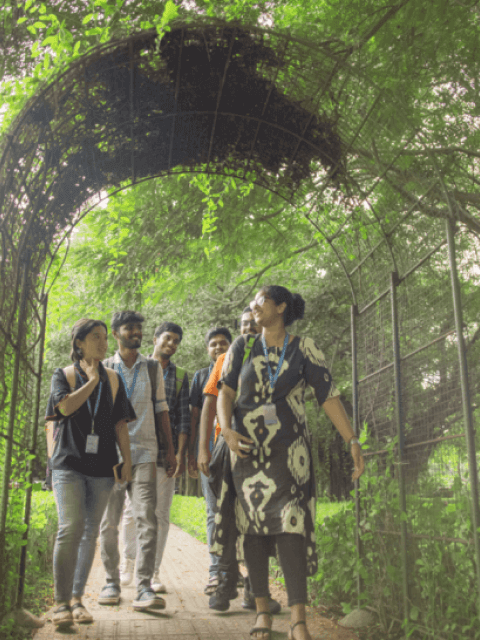
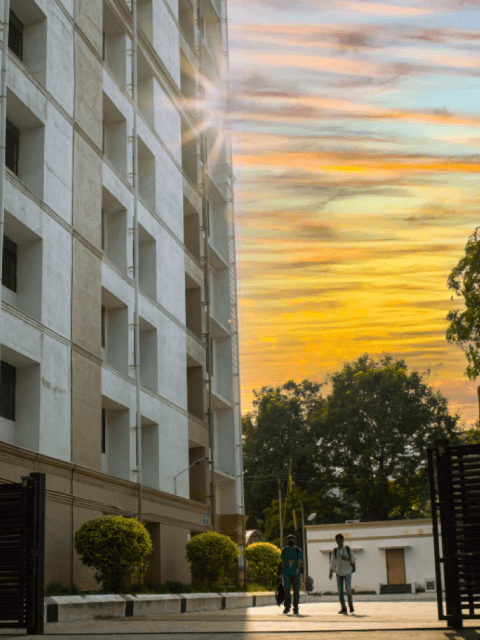
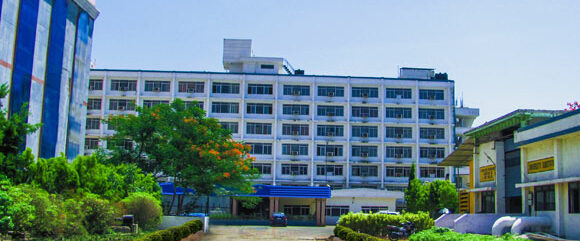
The Kattankulathur campus is built as a self-contained township on a single large site off the GST Road. Teaching blocks for each college, departmental and research laboratories, a central library and hostels sit together, and the university's own NIRF filing confirms lifts or ramps and accessible toilets in more than 80% of its buildings, a concrete accessibility marker rather than a brochure claim.
The single largest piece of infrastructure is medical. SRM Medical College Hospital and Research Centre operates as a full teaching hospital on campus, and the university reported it running 1,626 beds with an average daily occupancy of 1,463 and outpatient attendance averaging 3,341 a day in 2023, per its NIRF 2025 medical submission. For MBBS students that means clinical training happens in-house; for the wider campus it means a hospital-grade facility sits inside the same gates as the engineering blocks.
Hostel
SRMIST hostel charges are published up front and billed separately from tuition, and they span a wide band because room type and sharing vary a lot. For first-year B.Tech and integrated M.Tech students in 2025-26, the official Kattankulathur hostel schedule lists room rent from Rs 45,000 a year for a non-AC shared room up to Rs 1,90,000 for a premium AC room, with mess charges of Rs 73,000 for most blocks rising to Rs 1,25,000 in the premium hostel.
| Accommodation | Hostel + mess, all-in per year |
|---|---|
| Non-AC, common washroom, 4-5 sharing | Rs 1,18,000 |
| AC, attached washroom, 2 sharing | Rs 2,43,000 |
| Premium AC, attached washroom, 3 sharing | Rs 3,15,000 |
Laundry is an optional add-on of Rs 7,500. Booking is done through the student portal after a seat is accepted, and the all-in figures above are the ones to budget against, not the bare room rent, because the mess charge is where a large slice of the annual cost sits.
Faculty
SRMIST returned 4,466 faculty members across the university in its NIRF 2025 filing, one of the larger teaching bodies among private universities and a direct consequence of running so many faculties on one campus. Within that, the engineering college alone accounted for 1,661 of the faculty entered in NIRF, and the medical college a further 285.
The doctoral base is substantial for a self-financed university: the same filings record 1,760 full-time and 881 part-time Ph.D scholars across the university's programmes. A large research-degree population matters to an undergraduate too, because it is what staffs project supervision and keeps labs active outside teaching hours, and it is the reason SRMIST holds a place in the NIRF research table and not only the teaching-weighted ones.
Notable Alumni
SRMIST's alumni cut across sport, cinema, technology and the boardroom, which is what you would expect from a campus this large. Test and IPL cricketer Murali Vijay and India spinner Varun Chakravarthy both studied at SRMIST, as did chess grandmaster Vishnu Prasanna, who coaches world champion Gukesh D.
On the technology and public-policy side, Sriram Krishnan, the investor who took on a senior artificial-intelligence policy role in the United States administration, is an SRMIST graduate, and the university counts several Tamil-cinema actors and musicians among its former students. The people above are limited to graduates with a public, checkable footprint; SRMIST's own alumni network lists many more whose achievements we could not independently confirm, so they are left off rather than reprinted on trust.
News & Articles
The most recent verifiable institutional milestone is on accreditation: NAAC re-accredited SRMIST at its top A++ grade, with a CGPA of 3.58 recorded in the university's 2025 NIRF filing. We do not run a live notice feed here, so for SRMJEEE phase dates, counselling schedules and fee notifications the dated source is the SRMIST admissions portal, which is what actually binds each cycle.
College Compare
Against its nearest Chennai and deemed-university peers, SRMIST's edge is its NIRF university standing and its multi-faculty scale on a single campus. On the same NIRF 2025 university list it sits well above Chennai neighbours such as Sathyabama, and it competes with Vellore's VIT and Coimbatore's Amrita in the private-deemed engineering bracket rather than with the government IITs and NITs, whose seats are filled through JoSAA counselling on an entrance SRMIST has no part in.
Compare by intent rather than by one overall label. If you are set on computer science, set SRMIST's roughly Rs 6,20,000 B.Tech median beside VIT's and Amrita's for the same branch, because a campus-wide average hides the branch you actually care about. If you want medicine, the real comparison is other NEET-driven private colleges on fees and bond terms, not the engineering peers at all. Line each option up on its own NIRF standing and its published fees before you decide.
Contact & Location
SRMIST's main campus is at Kattankulathur, in the Chengalpattu district of Tamil Nadu, and it is reachable on the Chennai suburban rail line that runs down the same corridor as the GST Road. The Ramapuram and Vadapalani campuses sit inside the city, which matters if commuting rather than hostel living is your plan.
| Detail | Value |
|---|---|
| Main campus | Kattankulathur, Chengalpattu district, Tamil Nadu |
| Location | About 35 km south of Chennai, off GST Road (NH-32) |
| City campuses | Ramapuram and Vadapalani, Chennai |
| Other campuses | Tiruchirappalli and Delhi-NCR |
| Official website | srmist.edu.in |
For the full postal address, department phone numbers and the admissions email, use the contact pages on the official website. The campus you apply to is fixed at counselling, so confirm which campus offers a given branch before you accept a seat.
Verified
Approvals & Accreditation
Statutory approvals and accreditation grades from official bodies.
Aid
Scholarships
Decide
Compare with similar colleges
Voices
Student Reviews
Campus
Gallery

Questions
Frequently asked questions
References
Sources
- began in 1985 – en.wikipedia.org
- SRMIST admission brochure – webstor.srmist.edu.in
- Official website – srmist.edu.in
- NIRF 2025 ranking – nirfindia.org
At a glance
Quick facts
- Established
- 1985
- NIRF 2025 (Agriculture)
- Rank #33NIRF· 2025-08-14
- NAAC
- A++, CGPA 3.58
- Website
- srmist.edu.in

Expertie Editorial Team
This page is researched and maintained by the Expertie editorial team, and checked against official sources.
Found something that looks wrong? Email us at editorial@expertie.com.
Last updated