

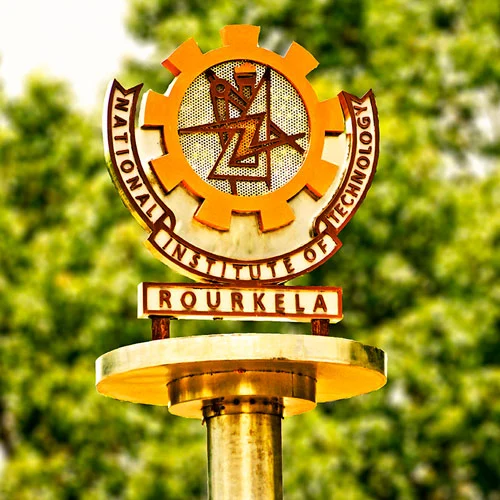
National Institute Of Technology, Rourkela
NIT Rourkela is the highest ranked NIT after Tiruchirappalli on the government's NIRF 2025 engineering list, and it sits in an unusual place among the country's technical schools: a campus built beside a steel plant, with metallurgy, mining and ceramic engineering in its founding DNA rather than bolted on later. If you are weighing a seat here against another NIT or an IIT, the questions that actually decide it are narrow, the fee bill, the JEE Main rank a branch takes, and what placements look like once you are inside. This page pins each of those to a source you can open.
Overview
The institute opened in 1961 as Regional Engineering College Rourkela, one of the joint Centre and state colleges of that era, and its location in the steel city of Rourkela in Odisha's Sundargarh district was never incidental: the Wikipedia record traces its early work to the metallurgy and mining that the surrounding industry needed. Two upgrades followed. Deemed-university status arrived in 2002, and by 2007 the institute had been folded into the schedule of the National Institutes of Technology Act, the tier of national importance it shares with the older NITs and the IITs.
That heritage shows up in the department list in a way it does not at most engineering schools. Alongside the usual computer science, electrical and mechanical branches, Rourkela runs full departments in metallurgical and materials engineering, mining engineering and ceramic engineering, the last of which is rare enough that few Indian campuses teach it as a degree. Its architecture programme is strong too, placing 7th in the country in NIRF 2025, so the institute is not read only through its engineering table.
Courses & Fees
Undergraduate teaching runs across B.Tech, the five-year B.Tech and M.Tech dual degree, B.Arch and the integrated M.Sc., with postgraduate M.Tech admitted through GATE and the centralised CCMT process, plus M.Sc., MBA, M.A. and a large Ph.D. programme. The table below maps the main entry routes.
| Programme | Typical duration | Entrance route |
|---|---|---|
| B.Tech | 4 years | JEE Main, then JoSAA and CSAB |
| B.Tech and M.Tech Dual Degree | 5 years | JEE Main, then JoSAA and CSAB |
| B.Arch | 5 years | JEE Main Paper 2, then JoSAA |
| Integrated M.Sc. | 5 years | JEE Main, then JoSAA |
| M.Tech | 2 years | GATE, then CCMT |
| MBA, M.Sc., M.A., Ph.D. | 1 to 5 years | Institute and national tests |
The fee is where NITs differ sharply from the IITs, because the tuition line alone is higher. A B.Tech student pays a tuition fee of Rs 62,500 each semester, and the official 2026-27 admission circular sets the first semester bill at Rs 1,36,500 once the one-time admission, caution money and emergency-fund charges are added, then about Rs 1,11,500 for most later semesters.
| Fee component, B.Tech | Amount |
|---|---|
| Tuition fee (each semester) | Rs 62,500 |
| First semester total (with one-time charges) | Rs 1,36,500 |
| Each later semester (typical) | Rs 1,11,500 |
| Mess advance (each semester) | Rs 30,000 |
| Hostel seat rent (each semester) | Rs 5,000 |
The tuition line is not fixed for everyone. The middle income slab, an annual family income between Rs 1 lakh and Rs 5 lakh, brings the semester tuition down to Rs 20,833, while an income under Rs 1 lakh, or a place in the SC, ST or PwD categories, removes it altogether, under the same circular. Rourkela makes that waiver conditional on income certificates for both parents, so the paperwork, not the branch, decides the final bill.
Admissions
Every undergraduate seat is filled through the Joint Seat Allocation Authority after JEE Main, with the leftover seats going to the CSAB special rounds, and Rourkela's own admission circular fixes physical reporting on campus between the 13th and 18th of August 2026. As a centrally funded NIT, half its seats are reserved for Odisha candidates under the home-state quota and half are open to the rest of the country, so an Odisha domicile usually clears a given branch at a softer rank than an applicant from outside the state.
The document verification is branch-grouped over several days, and candidates upgraded in a later JoSAA round have to carry the fresh allotment letter even when nothing changed. Postgraduate M.Tech entry is separate: a valid GATE score routed through CCMT, while Ph.D. admission runs on the institute's own written test and interview cycle.
Cutoff
Rourkela sets no entrance test of its own and runs no management quota, so a branch is won or lost entirely on your JEE Main All India rank as it moves through the JoSAA rounds and then the CSAB special rounds. What you are really choosing when you fill preferences is a branch and a quota together, because the rank that clears a seat depends on both.
The category you apply under, whether general, OBC-NCL, EWS, SC, ST or PwD, carries its own closing rank, and it stacks on top of the home-state and other-state split that governs every NIT seat. Within the branch list, computer science and the newer artificial-intelligence programme sit at the tight end of Rourkela's order, while its signature core streams, metallurgy, mining and ceramic engineering, admit at noticeably wider ranks, which is where a determined core-branch aspirant finds room. Those figures reset every cycle, so the number to trust is the one on the current-year JoSAA and CSAB seat allocation board for your own category and quota.
Placements
Rourkela publishes two honest signals, and they say different things. Its NIRF 2025 engineering data submission records a median package of Rs 15.25 LPA for the four-year B.Tech cohort of 2023-24, with 821 students placed, about 81 percent of the batch, a figure also carried in the aggregated placement summary. The median matters more than any headline here, because it is the middle of the class rather than the top of it.
The 2025 drive was the busier one. The institute's placement cell reported 1,274 offers, a highest package of Rs 62.44 LPA and a B.Tech average of Rs 14.10 LPA, with the M.Tech average at Rs 13.48 LPA and 373 recruiters on campus, according to the 2025 placement report. Ceramic engineering, one of the institute's signature departments, actually placed the highest share of any branch that year at 97.73 percent.
| Placement metric | Value |
|---|---|
| Median package, B.Tech UG (NIRF 2025, 2023-24) | Rs 15.25 LPA |
| Students placed, B.Tech (NIRF 2025) | 821, about 81 percent |
| Total offers, 2025 drive | 1,274 |
| Highest package, 2025 drive | Rs 62.44 LPA |
| Average package, B.Tech, 2025 drive | Rs 14.10 LPA |
| Recruiters on campus, 2025 drive | 373 |
Seat Matrix
Seats are allotted branch by branch through JoSAA and CSAB, split evenly between the Odisha home-state pool and the all-India other-state pool, with the standard SC, ST, OBC-NCL, EWS and PwD reservations layered on and a supernumerary quota for female candidates on top of that. The undergraduate intake spans the full department set, from computer science, electrical, mechanical, civil, chemical and the electronics branches to the metallurgical, mining, ceramic, biomedical, industrial-design and food-processing programmes named in the admission circular. Per-branch and per-category counts are set fresh in each year's JoSAA seat matrix, so read that live list rather than a static figure.
Rankings
Rourkela's strongest showing is in engineering, where it holds 13th place in the country on a score of 66.62 in the NIRF 2025 engineering ranking. The component profile behind that score is the part worth reading: its teaching resources and graduation outcomes rate high, while perception is comfortably the weakest of the five NIRF measures, the shape of an institution whose teaching and student outcomes outrun its brand recognition.
Its reach does not stop at engineering. The same 2025 cycle places it 7th nationally for architecture, a top-ten finish that few engineering-first campuses manage, and it also earns a place in the overall and research tables that mix every discipline and every kind of institution.
Departments
The department structure is the real unit of choice at Rourkela, because your years are spent inside one of about twenty departments and schools listed in the institute record. Three of them set it apart from most peers: metallurgical and materials engineering and mining engineering carry the industrial lineage of the steel city, and ceramic engineering is offered as a full B.Tech that only a handful of Indian institutions run.
Beyond those, the campus teaches the mainstream computer science, electrical, mechanical, civil, chemical and electronics branches, alongside newer programmes in biomedical engineering, industrial design and food-process engineering, and a School of Management and departments of planning and architecture, life science, chemistry, physics and mathematics. The spread means the institute admits well beyond the software track that dominates most engineering searches.
Facilities & Infrastructure
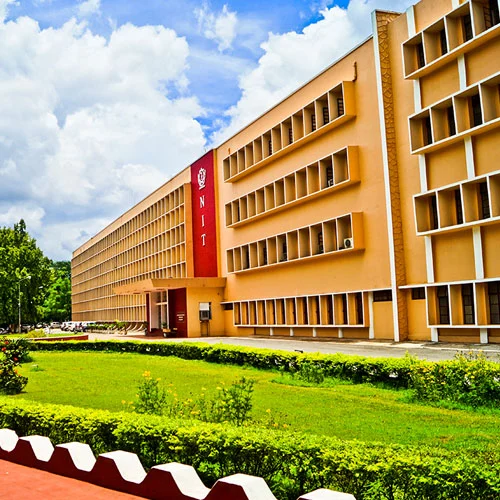
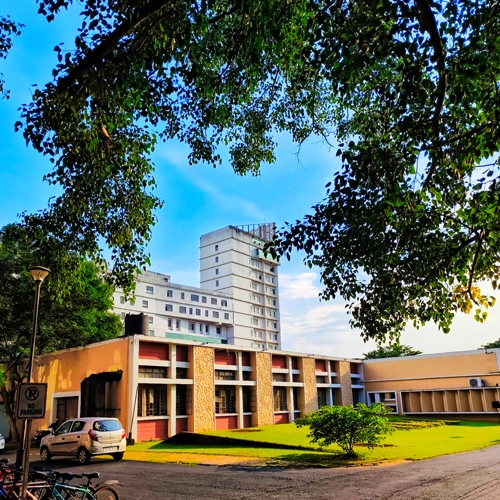
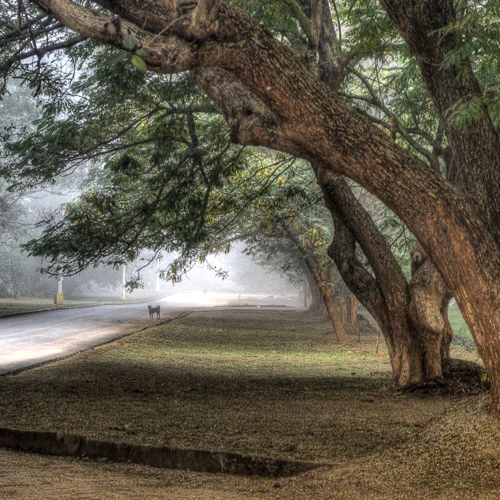
The campus runs to about 650 acres in the documented record, a self-contained township of academic blocks, laboratories, residence halls and sports grounds rather than a set of buildings on a city street. A central library, department research laboratories and workshop facilities anchor the academic side, and the wide, tree-lined avenues and open grounds are a visible part of what students describe about the place.
Because it grew out of a steel-town REC, the heavier engineering infrastructure is more developed here than the campus size alone would suggest, from the metallurgical and ceramic engineering laboratories to the mining department's workshops and the materials-testing facilities that the surrounding industry once drew on.
Hostel
Residence is effectively part of the package: the admission circular routes incoming boys to the VS Hall of Residence and girls to the KMS Hall of Residence for reporting, and the halls run on a fixed charge set out in the fee circular. Hostel seat rent is Rs 5,000 a semester and the mess advance is Rs 30,000 a semester, which is the single largest recurring cost after tuition and the reason the semester total sits where it does.
Mess is run on an advance-and-adjust basis, so the Rs 30,000 figure is an approximate deposit against actual dining rather than a flat fee. Room allocation across the various halls follows the institute's own hostel administration each year.
Faculty
Teaching is organised strictly by department, and each one publishes its own faculty profiles marking members as professor, associate professor or assistant professor, which is the level to read before you commit to a branch. There is no institute-wide staff tally on the official pages either, so the department profile lists are as granular as Rourkela's own numbers get, which is exactly why faculty totals differ from one listing site to the next.
The research depth is easiest to see in the specialised departments: the metallurgical, ceramic and mining groups carry the institute's strongest publication and doctoral record, which is where its national research standing comes from. For an applicant, the practical read is to look at the specific department's faculty and research pages for the subject you want.
Notable Alumni
The alumni record leans toward industry leadership rather than public celebrity. Soma Mondal, who went on to chair the Steel Authority of India, and C.P. Gurnani, the former chief executive of Tech Mahindra, are among the best known names in the alumni record, a fitting pair for an institute built next to a steel plant.
The list also includes Nalini Ranjan Mohanty, a former chairman of Hindustan Aeronautics Limited, and Prasant Kumar Mohapatra, who became a provost in the American university system. The pattern across those four, steel, aerospace, IT services and academia, tracks the institute's own engineering base rather than the entertainment or sport that headline other campuses.
News & Articles
The most recent institute-level news worth an applicant's attention is the 2025 placement season, which closed with 1,274 offers and a highest package of Rs 62.44 LPA across the B.Tech and M.Tech batches, reported in the 2025 placement coverage. Anything dated after that, a revised fee line, a counselling deadline, a fresh admission notification, lands first in Rourkela's own announcements section, which is why this page sends you there rather than restating a feed that would go stale within a cycle.
College Compare
Among the NITs, Rourkela's 13th place in NIRF 2025 engineering puts it second only to NIT Tiruchirappalli at 9th, and clear of NIT Karnataka Surathkal at 17th and NIT Warangal at 28th, on the engineering ranking. Calling it the second highest ranked NIT in the country this year is the honest read, not a marketing line.
The more useful comparison for most applicants is not against the IITs on rank but on fit. A student set on metallurgy, mining or ceramics has a stronger case for Rourkela than for a higher-ranked school that runs those subjects as minor departments, because here they are the institute's oldest and deepest strengths. Where the branch of interest is computer science, the choice tilts back toward whichever campus a given rank can actually reach.
Contact & Location
The institute is at Rourkela in the Sundargarh district of northern Odisha, about 8 kilometres from the city railway station. For anything admission-related, the undergraduate helpdesk below is the right first contact rather than a third-party number.
| Field | Detail |
|---|---|
| Address | NIT Rourkela, Rourkela, Sundargarh, Odisha |
| UG admission helpdesk | acad.ug@nitrkl.ac.in |
| Alternate admission email | ugpghelp@nitrkl.ac.in |
| Website | nitrkl.ac.in |
Verified
Approvals & Accreditation
Statutory approvals and accreditation grades from official bodies.
Aid
Scholarships
Decide
Compare with similar colleges
Voices
Student Reviews
Campus
Gallery
Questions
Frequently asked questions
References
Sources
- Wikipedia record – en.wikipedia.org
- Official website – nitrkl.ac.in
- NIRF 2025 ranking – nirfindia.org
- placement summary – getmyuni.com
- 2025 placement report – news.careers360.com
At a glance
Quick facts
- Established
- 1961
- NIRF 2025 (Architecture)
- Rank #7NIRF· 2025-08-14
- Website
- nitrkl.ac.in

Expertie Editorial Team
This page is researched and maintained by the Expertie editorial team, and checked against official sources.
Found something that looks wrong? Email us at editorial@expertie.com.
Last updated