

Indian Institute Of Technology, Indore
IIT Indore opened in 2009 and, in barely a decade and a half, has climbed to 12th among India's engineering institutions in the 2025 National Institutional Ranking Framework, ahead of several IITs a generation older. It occupies a 501-acre campus at Simrol, off the Khandwa Road south of Indore in Madhya Pradesh, and fills its B.Tech and B.S. seats through JEE Advanced and the JoSAA counselling that follows, with design admitted separately through UCEED. Its research output has grown quickly too, placing it 24th in the country for research.
Overview
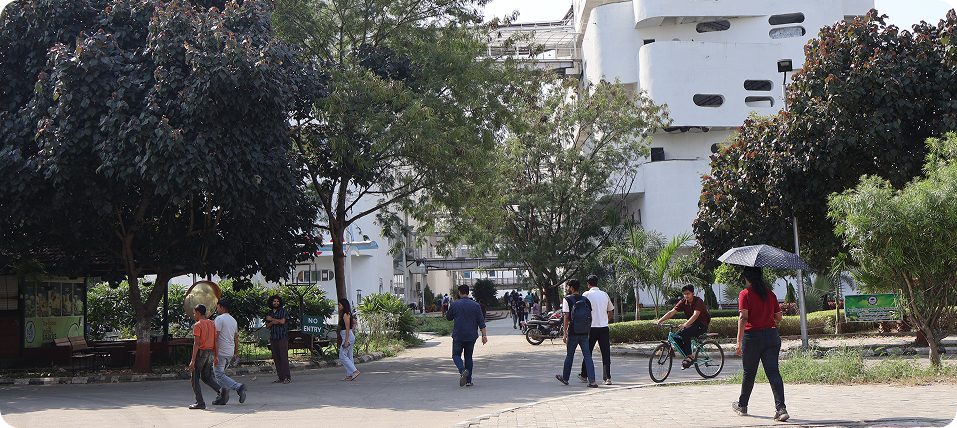
IIT Indore was set up by the Government of India in 2009 as one of the third-generation IITs, and for its first years it ran out of borrowed rooms at Devi Ahilya Vishwavidyalaya in the city while a permanent home was built, with IIT Bombay as its early mentor. The institute shifted to its own 501-acre residential campus at Simrol in 2016, a wooded site on the Khandwa Road that now houses almost the entire student and faculty community in one place.
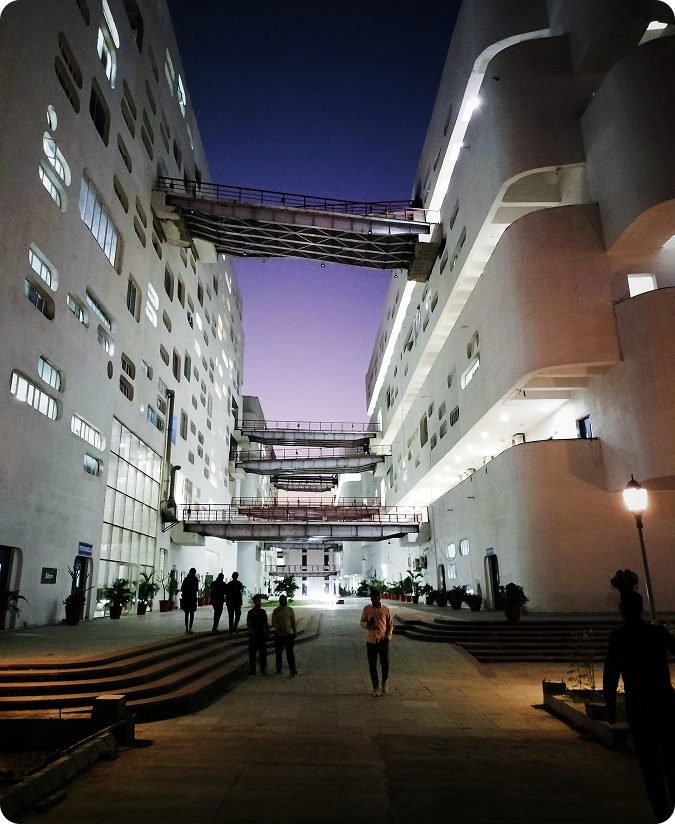
As an Institute of National Importance, IIT Indore sits in the same statutory tier as the older IITs, but its academic shape is its own. Alongside the usual engineering core it runs a full department of Astronomy, Astrophysics and Space Engineering, and it has built visible strength in physics, chemistry, computer science and metallurgy rather than spreading itself thin. At the centre of Simrol stands the POD complex, its Pool of Departments, a run of tall blocks joined by elevated walkways that holds much of the teaching and laboratory space.
Courses & Fees
The undergraduate offer at Simrol runs across three streams, with postgraduate and doctoral study layered on top, and each programme is reached through the one entrance exam named beside it.
| Programme | Level | Entrance route |
|---|---|---|
| B.Tech | Undergraduate | JEE Advanced, then JoSAA |
| B.Des | Undergraduate | UCEED |
| B.S. | Undergraduate | JEE Advanced, then JoSAA |
| M.Tech / M.S. (Research) | Postgraduate | GATE |
| M.Sc | Postgraduate | IIT JAM |
| PhD | Doctoral | Institute selection and national fellowships |
Fees follow the pattern common to the IITs rather than anything Indore sets on its own. For the general category, B.Tech tuition is Rs 1,00,000 a semester. Students whose annual family income is below Rs 1 lakh pay no tuition at all, and SC, ST and PwD students are exempt whatever their income; families earning between Rs 1 lakh and Rs 5 lakh have two-thirds of the tuition waived. Hostel rent, mess charges and one-time admission and caution deposits are added on top of tuition, so the exact amount a first-year student pays is best read off IIT Indore's own fee notice on its academic portal, which the institute revises each session.
Admissions
Every B.Tech and B.S. seat at Simrol is filled through the pipeline the IITs share, and it is worth understanding as a sequence rather than a single test. A candidate first clears JEE Main, then qualifies in JEE Advanced, and finally fills a preference list in JoSAA, where an All India Rank and the branches a student is willing to accept together decide whether Indore makes an offer in a given round. Design aspirants take a separate path into B.Des through UCEED, while the sciences route in through JEE Advanced like the engineering streams.
Postgraduate entry is exam-specific: a valid GATE score for M.Tech and M.S. by research, and IIT JAM for the two-year M.Sc programmes. Doctoral admission runs on the institute's own selection alongside national fellowships, and it is the largest programme on campus by head count. Reservation and supernumerary rules follow the central norms that apply across every IIT.
Cutoff
IIT Indore publishes no cutoff of its own, because the deciding number is fixed outside the institute during counselling. JoSAA produces closing ranks round by round, and they shift with how many higher-ranked candidates put Simrol above their other options in a given year. The computer science seats close at the tightest ranks here, ahead of the newer engineering and science branches, and the spread between the most and least sought branches is wide.
So the figure to plan against is the previous year's JoSAA closing rank for the exact branch and category a student wants, read for the round they expect to be called in. Because a campus whose profile is rising tends to draw stronger preference lists each cycle, that closing rank is best treated as a guide that can move against a candidate, not a fixed bar.
Placements
Placement outcomes at IIT Indore are best judged from the medians the institute reports to NIRF, which cover the whole graduating class rather than a single headline offer. For the batch that finished in 2023-24, the median annual salary was Rs 19,48,000 across 234 undergraduates placed out of 331 who graduated, with 27 more choosing to continue into higher study. The three-year run of undergraduate outcomes is set out below.
| Graduating batch | Graduated | Placed | Median salary |
|---|---|---|---|
| 2021-22 | 247 | 209 | Rs 18,50,000 |
| 2022-23 | 281 | 238 | Rs 21,20,000 |
| 2023-24 | 331 | 234 | Rs 19,48,000 |
The honest reading is that the undergraduate median has held in the high teens to low twenties in lakh terms while the graduating class itself has grown. Postgraduate outcomes sit lower, as they do across the IITs: the 2023-24 master's median was Rs 10,00,000, with 63 of 153 graduates placed and 49 going on to further study. A single highest-package figure makes better headlines than guidance, which is why these medians, not a peak offer, are the honest basis for setting Indore beside another institute.
Seat Matrix
IIT Indore's sanctioned undergraduate intake has risen with the campus. The institute reported 397 sanctioned UG seats and 345 postgraduate seats for 2023-24 in its NIRF submission, spread across its engineering and science departments. That total is the ceiling; how it splits by branch, gender-neutral and female-only pools, and reservation category is not fixed year to year.
Because that intake of 397 is small next to the largest IITs, an individual branch at Indore can carry only a handful of seats, so the exact per-branch and per-category split, gender-neutral and female-supernumerary seats included, is worth reading straight from the current year's JoSAA seat matrix rather than inferred from the total. A branch that fills in a single round at a bigger IIT can stay open across several rounds here, which makes the live matrix the only count that reflects what is genuinely on offer when a student fills preferences.
Rankings
IIT Indore's standing has climbed on every NIRF axis at once, and the research rank has moved as sharply as the engineering one. The shift across the two most recent editions is set out below.
| Framework category | NIRF 2024 | NIRF 2025 |
|---|---|---|
| Engineering | 16 | 12 |
| Overall | 33 | 27 |
| Research | 27 | 24 |
Moving from 16th to 12th in engineering in a single year is a real jump in a table where the leading places rarely change hands, and the overall climb from 33rd to 27th tracks it. For a student weighing Indore against the older IITs, the trajectory matters as much as the current position: this is an institute the framework has been marking upward, not one holding steady.
Departments
Teaching and research at Simrol are spread across departments in the engineering disciplines, the natural sciences, the biosciences and the humanities, listed on the institute's academics pages. The table groups them by area.
| Department | Broad area |
|---|---|
| Astronomy, Astrophysics and Space Engineering | Space sciences |
| Biosciences and Biomedical Engineering | Engineering |
| Chemical Engineering | Engineering |
| Civil Engineering | Engineering |
| Computer Science and Engineering | Engineering |
| Electrical Engineering | Engineering |
| Mechanical Engineering | Engineering |
| Metallurgical Engineering and Materials Science | Engineering |
| Chemistry | Natural sciences |
| Mathematics | Natural sciences |
| Physics | Natural sciences |
| Humanities and Social Sciences | Humanities |
The Astronomy, Astrophysics and Space Engineering department is the one that sets Indore apart, since a standalone space-sciences department is uncommon in the IIT system. Metallurgical Engineering and Materials Science and the Physics department are the other groups a research-minded applicant should weigh before locking in a branch, and the biosciences department gives the campus a foothold in medical and biological engineering that the older technical IITs came to later.
Facilities & Infrastructure
The Simrol campus is planned as a single residential estate rather than a scatter of buildings, so its 501-acre site keeps classrooms, laboratories and living quarters within walking distance of each other. Much of the teaching and lab work happens in the central POD complex, and the departments share central instrumentation facilities on campus rather than each buying its own.
Because Indore was built new rather than retrofitted onto an older institution, its labs and lecture blocks are recent construction, and the campus has kept adding capacity as intake has grown. A student comparing it with an older IIT will find newer infrastructure on a smaller, more compact footprint, which is easier to cross on foot but offers less of the sprawl and heritage of a legacy campus.
Hostel
A room at Simrol arrives with admission rather than as a separate application, since IIT Indore keeps its whole community on the one wooded estate. Undergraduates, master's students and its large cohort of PhD scholars are all quartered on site, so daily life at Indore stays within walking reach of the departments and labs even though the campus lies well out of town.
Room rent and mess are billed on top of tuition and revised each session, so a first-year budget at Indore needs to set aside board and lodging beyond the semester tuition figure. Meals run through the campus dining system that every resident student is part of, rather than being arranged privately.
Faculty
IIT Indore's teaching strength has grown alongside its intake. The institute reported 229 faculty members in its 2025 NIRF data, up from 204 the year before, a rise that has tracked the addition of undergraduate seats and new laboratories.
The research culture is where those faculty numbers start to matter for a student. Doctoral study is the largest programme on campus, with 633 full-time PhD scholars, and the institute ran 265 sponsored research projects backed by 64 funding agencies alongside 117 consultancy projects in 2023-24. That concentration of doctoral scholars and funded work is what makes joining a research group as an undergraduate a realistic option here rather than a long shot.
Notable Alumni
The earliest students to finish at IIT Indore left in the mid-2010s, so its graduates are still building their careers rather than filling public rosters. With so much of the campus given over to doctoral and master's research, many of its strongest names are forming inside academia and industry R&D, where recognition is slower and quieter than in public life. Naming an alumnus here without a record that can be traced would be guessing, so this stays empty until those records exist; the institute's youth is the reason, not any shortage of talent.
News & Articles
IIT Indore posts its admission notices, recruitment and tender calls and event announcements on its own website, and the academic office in particular keeps the dated circulars that govern deadlines. Anyone tracking an application should follow those official notices directly, since a change such as a shifted counselling date shows up there before any secondary write-up catches up to it.
College Compare
The fair yardstick for IIT Indore is the cluster it now ranks among, not the founding IITs. Its 12th place in NIRF 2025 engineering sits just behind BITS Pilani at 11th and IIT (BHU) Varanasi at 10th, and a step ahead of NIT Rourkela at 13th and IIT (ISM) Dhanbad at 15th. Its score of 66.65 on that table was close enough to the institutes on either side that the ordering turns on small margins.
So the question is not whether Indore edges those neighbours by a place or two, but what each offers a particular student: the branch on offer, the placement median and the campus setting. Against the older and larger IITs it trades scale and a long alumni record for newer facilities and a ranking that has been rising, and that is the trade a student weighing it should price in honestly.
Contact & Location
IIT Indore sits at Khandwa Road, Simrol, Indore 453552, in Madhya Pradesh, the address the institute publishes on its own site. That official website is also the single place to find its current phone numbers, departmental emails and the directions it recommends for reaching the Simrol campus, which lies well beyond the city edge.
Indore is well connected by air and rail, so the campus is reachable despite that distance, and most visitors cover the final stretch out to Simrol by road. Prospective applicants planning a visit should confirm gate and hostel access with the institute first, since Simrol is a working residential campus rather than an open site.
Verified
Approvals & Accreditation
Statutory approvals and accreditation grades from official bodies.
Aid
Scholarships
Decide
Compare with similar colleges
Voices
Student Reviews
Campus
Gallery
Questions
Frequently asked questions
References
Sources
- Official website – iiti.ac.in
- B.Tech tuition is Rs 1,00,000 a semester – fees.iitm.ac.in
- NIRF 2025 ranking – nirfindia.org
At a glance
Quick facts
- Established
- 2009
- NIRF 2025 (Engineering)
- Rank #12NIRF· 2025-08-14
- Website
- iiti.ac.in

Expertie Editorial Team
This page is researched and maintained by the Expertie editorial team, and checked against official sources.
Found something that looks wrong? Email us at editorial@expertie.com.
Last updated