
Indian Institute Of Technology (banaras Hindu University), Varanasi
IIT (BHU) Varanasi is the one Indian Institute of Technology that was carved out of an older, larger university rather than built on a fresh site. Its engineering lineage starts in 1919 as Banaras Engineering College, hardens in 1968 when three colleges inside Banaras Hindu University fused into the Institute of Technology, and formally becomes an IIT in 2012 by an Act of Parliament, per the institute's own record and its published history. That backstory is not trivia. It explains why this IIT keeps departments that most of the newer IITs never had, and why its campus is a walk from the ghats of Varanasi instead of an isolated technology park.
Overview
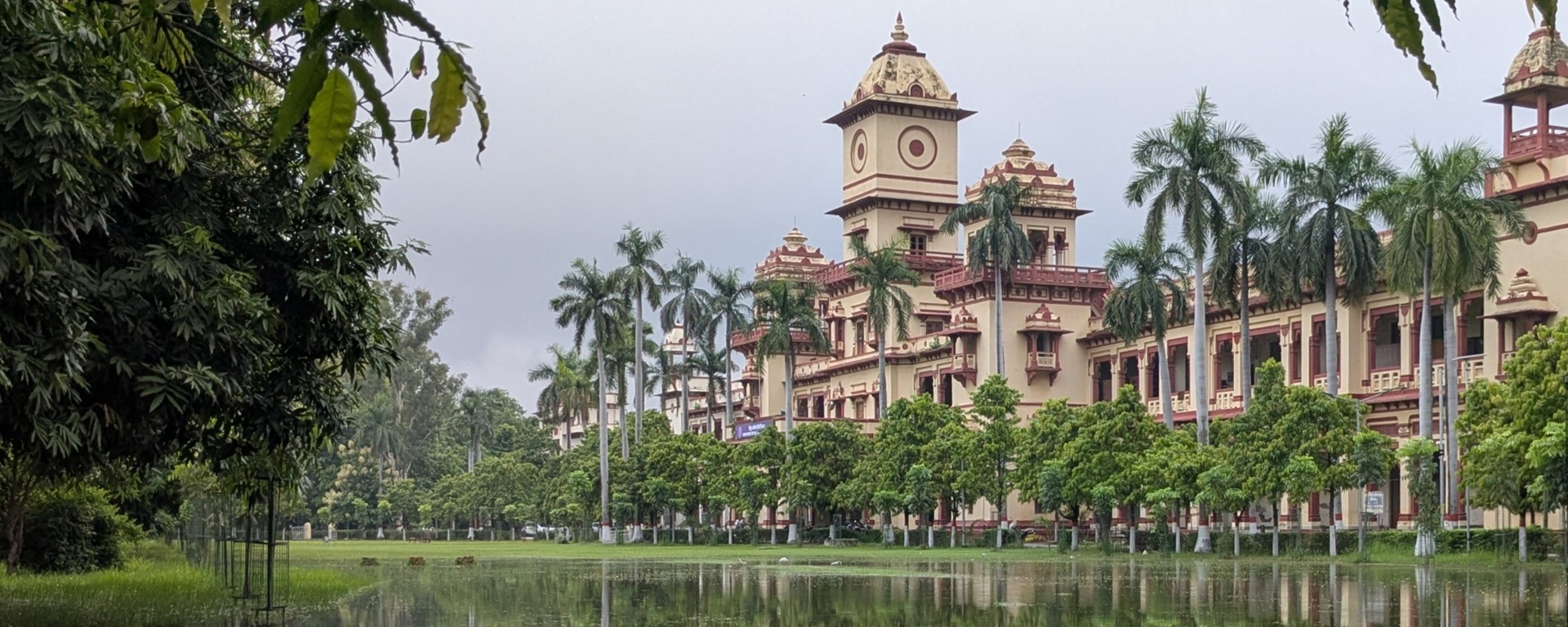
The institute sits inside the sprawling Banaras Hindu University estate in Varanasi, Uttar Pradesh, which makes it geographically unlike a standalone IIT that owns its own perimeter. It became an autonomous Institute of National Importance in 2012, so from that point its degrees, its Board of Governors and its admissions run separately from BHU even though the two share a postal address and a slice of the city. What a prospective B.Tech student is really choosing here is a technology school with a century of teaching behind it, ranked among the country's strongest engineering institutions, set in one of the oldest living cities in the world.
The tables below pull together the fee bands, the placement medians and the intake that students actually search for, each drawn from the institute's own fee circular and its NIRF submission rather than from aggregator estimates.
| Attribute | Detail |
|---|---|
| Type | Institute of National Importance (IIT) |
| Became an IIT | 2012, by Act of Parliament |
| Location | Within the BHU campus, Varanasi, Uttar Pradesh |
| UG entrance | JEE Advanced, then JoSAA seat allocation |
| NIRF 2025, Engineering | Rank 10 |
Courses & Fees
IIT (BHU) runs four-year B.Tech degrees across an unusually wide branch list and five-year Integrated Dual Degree (B.Tech plus M.Tech) options in several of those disciplines. Postgraduate study covers M.Tech, M.Pharm, M.Sc and doctoral research, the M.Pharm reflecting the institute's long pharmaceutics line. The seat-allocation profile lists the four-year branches as Ceramic Engineering, Chemical Engineering, Civil Engineering, Computer Science and Engineering, Electrical Engineering, Electronics Engineering, Engineering Physics, Industrial Chemistry, Materials Science and Technology, Mathematics and Computing, Mechanical Engineering, Metallurgical Engineering, Mining Engineering, Biochemical Engineering, Biomedical Engineering, and Pharmaceutical Engineering and Technology.
The fee is not one number. The institute's undergraduate fee circular sets tuition by family income and by category, so two students in the same classroom can pay very differently. For a general, OBC or EWS student whose family income is above ₹5 lakh a year, tuition is ₹1,00,000 each semester and the full semester fee comes to ₹1,06,350. The amount payable at admission adds the one-time charges, the refundable deposits and a ₹365 medical-insurance premium to that first semester, reaching ₹1,21,465, as set out in the official fee structure.
| Family income / category | Tuition per semester | Payable at admission |
|---|---|---|
| General / OBC / EWS, income above ₹5 lakh | ₹1,00,000 | ₹1,21,465 |
| General / OBC / EWS, income ₹1 lakh to ₹5 lakh | ₹33,333 | ₹54,798 |
| General / OBC / EWS, income below ₹1 lakh | Waived | ₹21,465 |
| SC / ST / PwD | Waived | Deposits and charges only |
The remission is steep at the lower income bands, and it comes straight from the same fee circular: tuition falls to ₹33,333 a semester for families earning between ₹1 lakh and ₹5 lakh, which takes the admission payment down to ₹54,798, and below ₹1 lakh the tuition is waived, so the admission payment drops to ₹21,465. Every regular SC, ST and PwD student is exempted from tuition and from the hostel seat rent as well. The one-time non-refundable charges add up to ₹5,750 and the refundable caution deposits to ₹9,000 for a general-category entrant.
Admissions
There is a single front door to the B.Tech and Integrated Dual Degree seats: JEE Advanced, taken after clearing JEE Main, with seats then allocated through the Joint Seat Allocation Authority rounds. A candidate does not apply to IIT (BHU) directly; the rank and the branch-and-college preference order submitted in JoSAA decide everything. The point that trips applicants up here, more than at any freestanding IIT, is that IIT (BHU) and Banaras Hindu University are two separate institutions sharing one campus. Selecting IIT (BHU) in JoSAA has nothing to do with a BHU application through CUET; they are different exams, different counselling and different degrees. Postgraduate entry runs on its own exams, GATE for the M.Tech and M.Pharm seats and JAM for the M.Sc programmes, so a student's route in depends entirely on the level they are entering.
Cutoff
A cutoff at IIT (BHU) is a JoSAA closing rank, not a mark or a percentage, and it is set only after counselling ends, so no honest figure can be printed ahead of the cycle. What is worth understanding before you fill the form is how far apart this institute's branches sit. Because the branch list runs from mainstream computing to streams almost no other IIT teaches, the distance between the branch that shuts first and the branch that shuts last is unusually large here. The software-linked branches fill early; the heritage streams, Ceramic, Mining and Metallurgical Engineering, keep admitting at ranks well outside that top band, which is exactly what makes them reachable for a student who would not clear the cutoff for computer science. Seats still empty after the main rounds move to the CSAB special rounds. Read your own category's closing rank from the JoSAA data for the year you apply, not from a recycled table.
Placements
The most honest placement picture comes from the institute's own NIRF data report, which separates the four-year, five-year and postgraduate cohorts instead of blending them into one headline. For the batch that graduated in 2023-24, the four-year B.Tech cohort reported a median salary of ₹20,00,000, the five-year Integrated Dual Degree cohort a median of ₹21,16,000, and the two-year postgraduate cohort a median of ₹10,00,000, all recorded in the NIRF 2025 submission.
Placement is never universal, and the same report shows the split plainly. Of the four-year batch, 996 students were placed and 75 went on to higher studies; among the five-year students, 273 were placed and 38 chose further study; in the postgraduate batch, 196 were placed while 64 moved to higher studies, per the NIRF data report.
| Cohort (2023-24) | Median salary | Placed | Higher studies |
|---|---|---|---|
| B.Tech, 4-year | ₹20,00,000 | 996 | 75 |
| IDD, 5-year | ₹21,16,000 | 273 | 38 |
| PG, 2-year | ₹10,00,000 | 196 | 64 |
One figure here rewards a second look. The five-year Integrated Dual Degree median of ₹21,16,000 sits above the four-year B.Tech median of ₹20,00,000, an inversion you rarely see, because the dual-degree student leaves with a master's-level specialisation that specific recruiters pay more for. The two-year postgraduate median of ₹10,00,000 is lower not because those students place poorly but because the recruiter pool and the roles differ from the undergraduate campus drive.
Seat Matrix
The seat matrix is the count of sanctioned seats a student is competing for, fixed for a cycle before JoSAA opens. IIT (BHU) reported a sanctioned intake of 1,163 seats for its four-year programmes, 400 for the five-year programmes and 555 for the two-year postgraduate programmes in its NIRF 2025 submission. Those undergraduate seats are not spread evenly across branches: the rare heritage departments such as Ceramic and Mining Engineering run small intakes, so a single reserved-category seat in them can decide a student's admission, while the large computing and mechanical departments hold most of the numbers. Women candidates are allotted supernumerary seats above these totals. The exact branch-and-category grid is released by JoSAA for each year's counselling.
Rankings
IIT (BHU) is a top-ten engineering institution on the national list without being one of the original older IITs, which is a genuine achievement for a campus that only gained IIT status in 2012. It placed 10th in the Engineering category of the NIRF 2025 rankings. In the same edition it sits 31st on the Overall list and 22nd among research institutions. Internationally it features in the QS World University Rankings, where it is listed by QS among the ranked Indian institutions. The engineering rank is the one a B.Tech applicant should weigh most, since it scores teaching, research and graduation outcomes for exactly this kind of institute.
Departments
The department list is where IIT (BHU) stops resembling a generic IIT and shows its roots. Ceramic Engineering here descends from the old Department of Silicate Technology, and it is one of very few places in India offering a full four-year degree in the subject. Mining Engineering and Metallurgical Engineering trace directly to the College of Mining and Metallurgy that merged into the institute in 1968, giving it depth in materials and extraction that younger campuses cannot match. Pharmaceutical Engineering and Technology carries the pharmaceutics heritage, and the newer Materials Science and Technology, Biochemical Engineering and Biomedical Engineering schools sit alongside the core Computer Science, Electrical, Electronics, Mechanical, Civil and Chemical departments. Basic sciences and mathematics support all of them, so a student's electives can reach well outside their own branch.
Facilities & Infrastructure
Because the institute lives inside the BHU estate, its students effectively draw on two worlds: the dedicated IIT academic blocks, laboratories and workshops, and the wider university's libraries, medical facilities, temple, and cultural life. The campus carries a central library, department-level research labs built up over a century, and the Malaviya Centre for Innovation, Incubation and Entrepreneurship, which backs student and faculty startups. The setting in Varanasi means everyday access to a historic city rather than a sealed-off township, which some students value and others have to adjust to.
Hostel
Residential life runs through a large set of hostels, with separate blocks for men and women, each managed with its own mess. Hostel charges are billed separately from tuition: the undergraduate fee circular lists a refundable hostel caution deposit of ₹2,000, a hostel seat rent of ₹300 a semester, fan, electricity and water charges of ₹1,200 a semester, and a hostel development fund of ₹2,250 a semester, per the fee structure. Mess dues are collected on top of these and vary by hostel. SC, ST and PwD students are exempted from the hostel seat rent along with their tuition waiver.
Faculty
Teaching is carried almost entirely by regular, doctorate-holding faculty; the institute's NIRF submission lists its professors, associate professors and assistant professors individually, and the great majority hold a Ph.D and long tenure at the institute. Research depth shows in the doctoral population, with 1,123 full-time and 73 part-time Ph.D scholars recorded in the NIRF 2025 report. For an undergraduate that scale of a research programme matters, because it feeds project supervision, laboratory work and the chance to join real research early.
Notable Alumni
The institute's graduates, counting its IT-BHU years, reach the top of global technology and public life. Jay Chaudhry founded and leads the cloud-security company Zscaler; Nikesh Arora runs Palo Alto Networks after a spell as president of SoftBank; Deepak Ahuja served as chief financial officer at Tesla through its formative years. Beyond technology, Krishan Kant became Vice-President of India, and Varun Grover has won a National Film Award for his lyrics and writing, per the alumni record. The range, from a national office to Silicon Valley to Hindi cinema, tells you the network a student joins is not confined to one industry.
News & Articles
We do not maintain a running news feed for this institute. For dated announcements, admission notices, convocation news and recruitment alerts, the institute publishes them on its official website, which is the reliable place to check during an application cycle.
College Compare
A side-by-side comparison with another IIT depends on the branch and the outcome a student cares about, so a single verdict would mislead. The most useful comparison for IIT (BHU) is against the other older-generation IITs and the top NITs that a similar JEE Advanced rank also reaches, weighed branch by branch. Line up the fee bands, the NIRF engineering standing and the cohort-wise placement medians on this page against each rival's own official numbers, rather than trusting a ranked "best college" list.
Contact & Location
IIT (BHU) Varanasi sits within the Banaras Hindu University campus in Varanasi, Uttar Pradesh, at PIN 221005. Its official website is the first point of contact for admissions, departments and administrative offices.
| Label | Value |
|---|---|
| Address | IIT (BHU), Banaras Hindu University campus, Varanasi, Uttar Pradesh 221005 |
| Official website | iitbhu.ac.in |
| City | Varanasi |
Verified
Approvals & Accreditation
Statutory approvals and accreditation grades from official bodies.
Aid
Scholarships
Decide
Compare with similar colleges
Voices
Student Reviews
Campus
Gallery
Questions
Frequently asked questions
References
Sources
- Official website – iitbhu.ac.in
- published history – en.wikipedia.org
- seat-allocation profile – josaa.admissions.nic.in
- NIRF 2025 ranking – nirfindia.org
- QS – topuniversities.com
At a glance
Quick facts
- Established
- 2012
- NIRF 2025 (Engineering)
- Rank #10NIRF· 2025-08-14
- Website
- iitbhu.ac.in

Expertie Editorial Team
This page is researched and maintained by the Expertie editorial team, and checked against official sources.
Found something that looks wrong? Email us at editorial@expertie.com.
Last updated