

Indian Institute Of Management Ahmedabad
IIM Ahmedabad has held rank 1 in the Ministry of Education's NIRF management list every year since 2020, and its two-year MBA is still one of the hardest admits in Indian business education. The 2025-27 batch pays a programme fee of ₹27,50,000, and the 2025 graduating class left with an audited median package of ₹34.53 lakh. What actually converts a shortlist into a seat here is not the CAT percentile that gets you the interview call, but the personal interview itself, which carries the single largest weight in the final decision.
Overview
IIM Ahmedabad, known on campus and in the market as IIMA, was established on 11 December 1961 by the physicist Vikram Sarabhai and the industrialist Kasturbhai Lalbhai, set up in collaboration with the Harvard Business School and with support from the Ford Foundation and the governments of India and Gujarat, per its Wikipedia entry. Its first director was Ravi J. Matthai. It is a public postgraduate business school in the Vastrapur area of Ahmedabad, and it runs no undergraduate degree at all: every programme begins after a bachelor's, and the two-year MBA has been the flagship for more than five decades. Since the IIM Act, the institute awards its own MBA degree rather than the postgraduate diploma the older IIMs once issued.
Courses & Fees
The two-year MBA is IIMA's flagship. Alongside it the home page lists the MBA-FABM for food and agri-business, the one-year MBA-PGPX for experienced professionals, the two-year Blended MBA (MBA-BPGP), a Blended MBA in Business Analytics and AI, the ePGD-ABA diploma, and a doctoral programme, plus faculty development and advanced-management courses.
| Programme | Level and duration | Entry route |
|---|---|---|
| MBA (flagship PGP) | Postgraduate, two years, residential | CAT, then writing test and interview |
| MBA-FABM | Postgraduate, in food and agri-business management | CAT |
| MBA-PGPX | Postgraduate, one year, for working executives | Work experience and an admissions process |
| Blended MBA in Business Analytics and AI | Postgraduate, blended online and on-campus | Own criteria |
| ePGD-ABA | Post-graduate diploma in advanced business analytics | Own criteria |
| PhD (doctoral programme) | Doctoral | Own criteria |
The flagship MBA is described by the institute as a Two-Year Post Graduate Programme in Management: a year of compulsory foundation courses, then a second year in which participants build their own specialisation from electives. The PGPX is a One-Year Full Time programme for executives structured across six terms. Fees are set per programme and revised each batch, so only the flagship fee is quoted below; the others publish their own figure on each programme page.
| Programme | Fee | Source |
|---|---|---|
| MBA (2025-27 batch) | ₹27,50,000 total, of which ₹20,10,000 is tuition | MBA admissions, Indian candidates |
| Other programmes | Published per batch on each programme's own page | IIMA programmes |
For the flagship, the admissions page for Indian candidates puts the programme fee at ₹27,50,000 for the 2025-27 batch, of which ₹20,10,000 is tuition. That figure is bundled: it covers course material, campus accommodation, library and computing, since the programme is fully residential, but not a laptop, travel or personal living costs.
Admissions
Selection for the two-year MBA runs in stages, and where the weight sits is the whole story. A valid CAT score first has to clear a category percentile floor and then a shortlisting composite, which the admissions page builds from the CAT score, weighted 0.65, and an Application Rating drawn from your academic record, weighted 0.35. Candidates who clear that shortlist are called for an Analytical Writing Test and a Personal Interview. The final composite score then re-weights everything, and the interview, not the exam, dominates it.
| Selection stage | Component | Weight | Source |
|---|---|---|---|
| Shortlisting composite | CAT 2025 score | 0.65 | Admissions |
| Shortlisting composite | Application Rating | 0.35 | Admissions |
| Final composite | Personal Interview | 0.50 | Admissions |
| Final composite | CAT 2025 score | 0.25 | Admissions |
| Final composite | Application Rating | 0.15 | Admissions |
| Final composite | Analytical Writing Test | 0.10 | Admissions |
Read the second block plainly: in the final composite the Personal Interview is weighted 0.50 and the CAT score only 0.25, per the admissions page. The exam gets you into the room; the interview decides the seat. The eligibility floor is a bachelor's degree with at least 50% marks, relaxed to 45% for SC, ST and PwD candidates, and final-year students may apply provisionally.
Cutoff
IIMA does not admit on a rank the way engineering counselling does, so its cutoff is a CAT percentile that only qualifies you for the shortlisting stage. The admissions page sets a minimum overall percentile and a minimum in each of the three CAT sections, and both move by category.
| Category (non-PwD) | Minimum overall percentile | Minimum sectional percentile | Source |
|---|---|---|---|
| General and EWS | 95 | 85 | Admissions |
| NC-OBC | 90 | 80 | Admissions |
| SC | 85 | 75 | Admissions |
| ST | 75 | 65 | Admissions |
PwD candidates face lower floors in every category, running from an 85 overall for General and EWS down to 65 for ST, again per the admissions page. These are qualifying marks, not admission marks. Two General-category candidates who both clear the 95th percentile enter exactly the same pool, and from there the composite score and the interview separate them. Clearing the percentile is the start of the process at IIMA, not the end of it.
Placements
IIMA publishes an audited final-placement report under the Indian Placement Reporting Standards, and it reports Maximum Earning Potential, the actual first-year cash a graduate can earn, rather than an inflated cost-to-company figure. The numbers below are for the PGP 2025 batch.
| Metric (PGP 2025) | Value | Source |
|---|---|---|
| Median package (Maximum Earning Potential) | ₹34.53 lakh, up 7.9% year on year | Final placement report |
| Highest package | ₹1.1 crore | Final placement report |
| Recruiters | 178 | Placement summary |
| Distinct roles offered | 261 | Placement summary |
| Eligible students | 406 | Placement summary |
| Accepted an offer | 395 | Placement summary |
| Chose entrepreneurship or a family business | 11 | Placement summary |
The distance between that median and the ₹1.1 crore top offer is what most applicants misread: the top figure is a single outlier, while the median is the middle of the batch and the honest number to plan around, per the final placement report. Of the 406 eligible students, 395 accepted an offer and 11 stepped away by choice into entrepreneurship or a family business, so the batch was effectively fully placed, per the placement summary.
Seat Matrix
Rankings
IIMA has finished first in the Ministry of Education's NIRF management ranking every year since 2020.
| Ranking (2025) | Rank | Score | Source |
|---|---|---|---|
| NIRF Management | 1 | 83.29 | NIRF 2025 Management |
In the NIRF 2025 Management ranking it holds that first place with an overall score of 83.29, and its home page records the unbroken run at the top since 2020. The parameter profile shows where the lead is built: 98.72 on graduation outcomes and 93.26 on perception, both near the top of the 100-point scale, against a lowest mark of 64.92 on research and professional practice. Perception is the metric that stands in for how employers and academic peers rate a school. The same home page adds a global view: a 3rd career-progress rank for its one-year MBA in the Financial Times Global MBA Ranking 2026, a 23rd in the FT Executive Education (Open) ranking 2026, and 1st for agribusiness and food-industry management in the 2025 Eduniversal Best Masters ranking.
Departments
IIMA organises teaching and research into faculty Areas rather than conventional departments. Its faculty and research pages list twelve.
| Academic Area | Nature |
|---|---|
| Finance and Accounting | Discipline area |
| Marketing | Discipline area |
| Economics | Discipline area |
| Strategy | Discipline area |
| Organisational Behaviour | Discipline area |
| Human Resources Management | Discipline area |
| Information Systems | Discipline area |
| Operations and Decision Sciences | Discipline area |
| Communication | Discipline area |
| Centre for Management in Agriculture | Subject centre |
| Public Systems Group | Interdisciplinary group |
| Ravi J. Matthai Centre for Educational Innovation | Subject centre |
Alongside the expected finance, marketing and strategy Areas sit the Centre for Management in Agriculture, the Public Systems Group and the Ravi J. Matthai Centre for Educational Innovation, a long institutional interest in agriculture, public policy and pedagogy that most business schools leave to others. The same Areas teach across the MBA, the doctoral programme and executive education, and they anchor the institute's research centres, from the Brij Disa Centre for Data Science and Artificial Intelligence to the NSE Centre for Behavioral Science in Finance, Economics and Marketing.
Facilities & Infrastructure
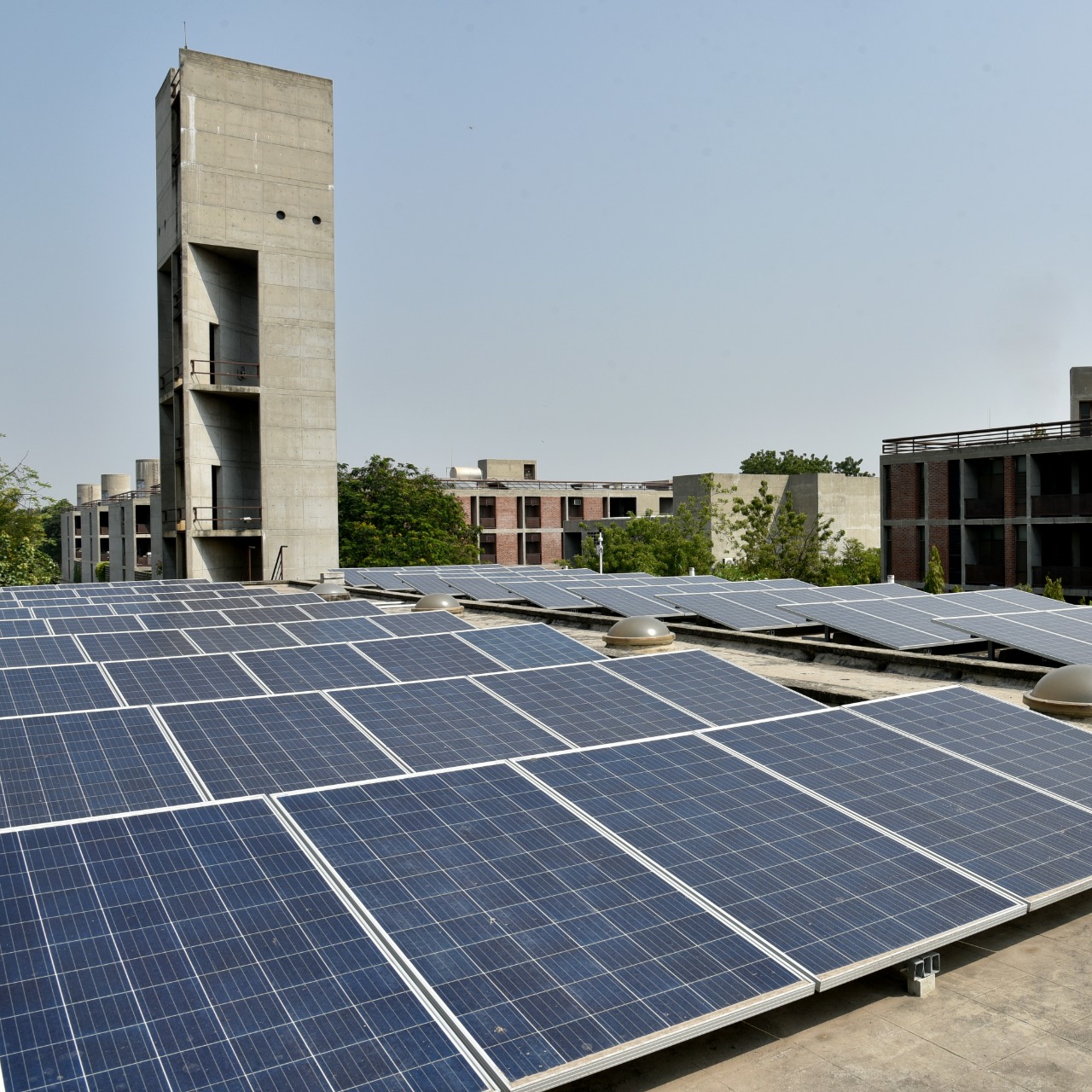
The oldest part of the campus is itself part of IIMA's reputation. The heritage precinct was laid out by the American architect Louis Kahn, who designed it between 1962 and 1974 in his signature exposed red brick, arches and open courtyards, per the institute's Wikipedia entry, and it remains one of the most studied pieces of modern architecture in India. The institute describes the campus as a mini city of 107 acres with facilities available inside it, on its home page, and at its centre sits the Vikram Sarabhai Library. Because the flagship MBA is fully residential, the bundled programme fee already covers accommodation along with library and computing access. The upkeep of the brickwork is a live commitment: when the institute proposed in 2020 to demolish 14 of the ageing dormitory blocks, an international campaign led it to withdraw the plan in January 2021 and restore them instead.
Hostel
The two-year MBA is a residential programme, so admitted students live on campus for its full duration, which is why accommodation is folded into the bundled programme fee rather than billed separately. Housing is built around the dormitory blocks of the Louis Kahn campus: the heritage precinct includes 18 dormitories built between 1962 and 1974, per IIMA's Wikipedia entry. IIMA does not publish a hostel tariff separate from that composite fee.
Faculty
IIMA's faculty are grouped by the same twelve faculty Areas and centres that organise its teaching, and the same people carry the research. The Areas run the institute's research centres and its case-writing tradition, which is the method most of the MBA is taught through. Names associated with the faculty over the years include the economist C. Rangarajan and the management scholar C. K. Prahalad, per its Wikipedia entry. The institute lists its current professors by Area in an online directory rather than as a single headline count, so the roster is best read there, Area by Area, rather than reduced to one figure.
Notable Alumni
IIMA's flagship MBA counts a Reserve Bank governor, a World Bank president and a best-selling novelist among its documented graduates. The list below is drawn from the institute's Wikipedia entry and is limited to widely documented alumni.
| Alumnus | Known for |
|---|---|
| Raghuram Rajan | Economist and former Governor of the Reserve Bank of India |
| Ajay Banga | President of the World Bank and former chief executive of Mastercard |
| K. V. Kamath | Banker, former head of ICICI Bank and of the New Development Bank |
| C. K. Prahalad | Management theorist and author |
| Chetan Bhagat | Author |
| Deep Kalra | Founder of MakeMyTrip |
| Harsha Bhogle | Cricket commentator |
The spread matters more than any single name: the same programme has produced a central-bank governor, a multinational chief executive and a best-selling novelist, which is a fair signal of how broadly an IIMA MBA travels beyond the consulting and finance roles that dominate its placement report.
News & Articles
College Compare
Contact & Location
IIMA sits on its New Campus in the Vastrapur area of western Ahmedabad, Gujarat.
| Detail | Information |
|---|---|
| Address | Indian Institute of Management Ahmedabad, Vastrapur, Ahmedabad, Gujarat 380015, India (Wikipedia) |
| City and state | Ahmedabad, Gujarat |
| Campus | Vastrapur, spanning the Louis Kahn heritage campus and the newer campus |
| Official website | iima.ac.in |
Programme-specific queries are best routed through the relevant admissions page rather than a single switchboard, since each programme at IIMA runs its own office.
Verified
Approvals & Accreditation
Statutory approvals and accreditation grades from official bodies.
Aid
Scholarships
Decide
Compare with similar colleges
Voices
Student Reviews
Campus
Gallery
Questions
Frequently asked questions
References
Sources
- Wikipedia entry – en.wikipedia.org
- Official website – iima.ac.in
- NIRF 2025 ranking – nirfindia.org
At a glance
Quick facts
- Established
- 1961
- NIRF 2025 (Management)
- Rank #1NIRF· 2025-08-14
- Website
- iima.ac.in

Expertie Editorial Team
This page is researched and maintained by the Expertie editorial team, and checked against official sources.
Found something that looks wrong? Email us at editorial@expertie.com.
Last updated