

Indian Institute Of Management Indore
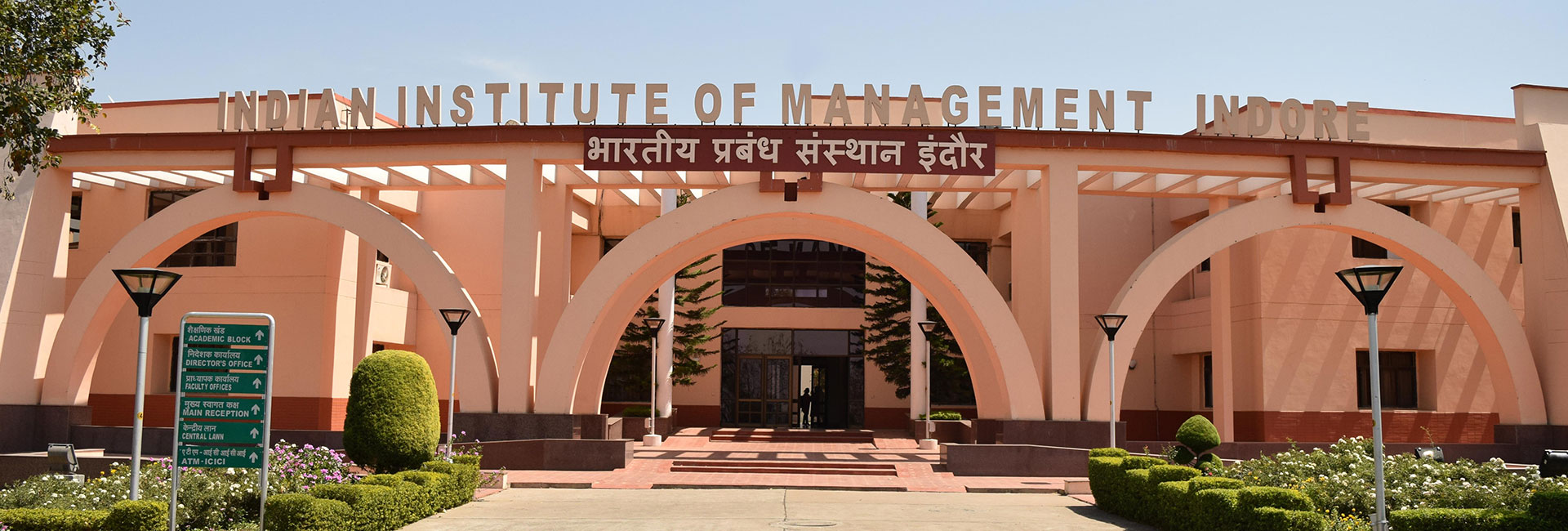
IIM Indore is the sixth Indian Institute of Management, set up in 1996 on a hilltop campus at Rau, on the Rau-Pithampur road outside Indore in Madhya Pradesh. It is best known for two things a prospective student weighs differently: a two-year MBA reached through CAT that placed the institute eighth in the country on the NIRF 2025 management list, and the five-year Integrated Programme in Management (IPM) that admits students straight out of Class 12, a route IIM Indore built first among the IIMs. This page sets out what each programme costs, how the CAT and IPMAT selection actually works, and what the batch that graduated in 2025 was paid.
Overview
IIM Indore runs as an autonomous institute of national importance under the IIM Act, and its campus name, Prabandh Shikhar, translates roughly as the peak of management, a nod to the hill the academic block sits on. The 193-acre site listed on the institute's own profile makes it one of the more spacious IIM campuses, and the institute holds the Triple Crown of international business-school accreditation, AACSB, AMBA and EQUIS, a set that only a handful of Indian schools carry. Beyond the Indore campus it operates a Mumbai campus used mainly for executive and management-development teaching.
The programme mix is wider than the flagship MBA alone. Alongside the Post Graduate Programme in Management (PGP) and the five-year IPM, the institute offers a PGP in Human Resource Management, an executive post-graduate programme (EPGP), a doctoral Fellow Programme, and a large slate of executive-education courses. What ties the profile together is a case-based, participant-centred teaching style that the institute states as its core method.
Courses & Fees
The binding figure for a general-category Indian student is the fee published for each programme on the institute's admissions pages, and it differs sharply between the postgraduate MBA and the integrated route. The PGP course fee is billed in instalments across the two years rather than as a single lump sum, and the mess and caution components sit on top of it.
Two different numbers are in circulation for the PGP, and both come from IIM Indore, so it is worth separating them. The figure the institute quotes today on its PGP programme page is a course fee of 24,11,800 for the two years for resident Indians, and 36,11,800 for NRI candidates, inclusive of alumni fee and lodging but not of textbooks, mess or insurance. That supersedes the older per-year figure below, which is the last schedule the institute has published as a full itemised table, and which is reproduced here because it is the only source that shows how the mess, caution and insurance components are actually billed.
For the two-year PGP, the official fee schedule for the 2024-26 batch set the course fee at 10,00,000 per year for Indian students admitted through CAT.
| PGP (MBA) 2024-26, Indian students | Amount (Rs) |
|---|---|
| Course fee, first year (2024-25) | 10,00,000 |
| Course fee, second year (2025-26) | 10,00,000 |
| Grand total, first year (with mess, caution, insurance) | 11,04,679 |
| Grand total, second year | 10,12,479 |
| Refundable caution deposit (one time) | 50,000 |
The course fee does not cover textbooks, and the caution deposit is returned when the programme ends. NRI and foreign-national candidates admitted through GMAT pay a higher course fee of 15,00,000 per year under the same schedule.
The five-year IPM is priced lower in its early years because the first three are undergraduate-style foundation years. The same split between a current headline and a last itemised schedule applies here: the IPM programme page now states a course fee of 6,00,000 per annum for domestic applicants across those three years, and 9,00,000 for international applicants, both flagged as subject to revision. The IPM fee schedule for the 2024-29 batch fixed the course fee at 5,00,000 per year for the first three years for domestic applicants, and it is that batch's itemisation the table below sets out.
| IPM (five-year) 2024-29, domestic | Amount (Rs) |
|---|---|
| Course fee per year, years one to three | 5,00,000 |
| Grand total, first year (with mess, caution, insurance) | 6,04,679 |
| Grand total, each of years two and three | 5,54,679 |
| Mess deposit per year | 54,000 |
For the fourth and fifth years of the IPM the course fee steps up to whatever the prevailing PGP fee is, since those years overlap with the MBA stage. Need-based financial assistance is administered by the institute for admitted students whose family circumstances qualify, and the details are issued to selected candidates with the admission offer.
Admissions
Getting into IIM Indore runs through two entirely separate front doors, and which one a candidate uses depends on their stage of study rather than their preference. Graduates apply to the PGP through CAT; school leavers apply to the IPM through IPMAT.
For the PGP, a candidate needs a bachelor's degree with at least 50% marks, relaxed to 45% for SC, ST and PwD applicants, and must appear in CAT, per the 2026-28 admission procedure. Selection then moves through three stages: a percentile-based eligibility screen, a shortlist for the personal interview built on a composite score, and a final merit list. The composite score for the interview shortlist draws on Class 10 and Class 12 records, the three CAT sectional scores, a diversity factor and work experience. Worth knowing before a candidate budgets their preparation: the personal interview is the only instrument IIM Indore adds after the shortlist for this cycle, and the same document notes that other IIMs set their own criteria and may call candidates for a group discussion or written ability test instead. What also shifts between the two stages is what counts. Class 12 marks carry 25 in the shortlisting composite but drop to 5 in the final one, where the interview score alone carries 45, against 20 for the VARC section and 10 for each of DILR and QA. A single application also puts the candidate in the running for the institute's PGP in Human Resource Management.
The IPM is the distinctive route, launched by IIM Indore in 2011 and the first of its kind in India. It takes students who have cleared Class 12, and it turns on two instruments only: the institute's admission procedure for the 2026-31 batch states that candidates are selected on overall performance in the Aptitude Test and the Personal Interview, and names no written ability test at any stage of the process. The Aptitude Test is sat in three separately timed sections of 40 minutes each, Quantitative Ability in multiple-choice form, Quantitative Ability in short-answer form, and Verbal Ability, with the short-answer section the only one that carries no negative marking. A candidate who misses either the test or the interview is out of consideration entirely. Those who complete all five years are awarded a Bachelor of Arts in Foundations of Management together with an MBA under a dual-degree structure. NRI and foreign candidates for the postgraduate MBA are considered on GMAT scores instead of CAT.
Cutoff
For the PGP, IIM Indore publishes not a closing rank but a floor: a set of minimum CAT percentiles a candidate has to clear before the composite score will even consider them. That floor is necessary but not sufficient, because the overall percentile and every sectional percentile have to be met together, with no trading a strong section against a weak one.
| Category | QA percentile | DILR percentile | VARC percentile | Overall percentile |
|---|---|---|---|---|
| General | 80.00 | 80.00 | 80.00 | 90.00 |
| EWS | 80.00 | 80.00 | 80.00 | 90.00 |
| NC-OBC | 70.00 | 70.00 | 70.00 | 80.00 |
| SC | 55.00 | 55.00 | 55.00 | 60.00 |
| ST | 40.00 | 40.00 | 40.00 | 45.00 |
| PwD | 40.00 | 40.00 | 40.00 | 45.00 |
A general-category applicant who scores above the 90th overall percentile but slips below the 80th in even one section is dropped at the eligibility stage, so section balance matters as much as the headline number.
The IPM has no CAT cutoff at all, and no published percentile table either. Its equivalent gate is a positive raw score plus a minimum mark in each of the three Aptitude Test sections, and the 2026-31 admission procedure leaves those minimums to the Admissions Committee to fix per category rather than announcing them in advance, so an IPM aspirant cannot check a number before applying the way a CAT candidate can. The shortlist that follows is drawn on an Aptitude Test Score weighting Verbal Ability 50 against 25 for each of the two Quantitative Ability sections, and the final merit list rests 65 on that test score and 35 on the interview.
Placements
The batch that finished in 2025 reached a 100% placement record with 225+ recruiters taking part, and the institute's final placement report for 2023-25 puts the average package at 29.57 LPA against a median of 27 LPA. That gap between average and median is the usual signal that a cluster of very high offers pulls the mean up, and the same report records a highest package of 70 LPA.
| Metric, 2023-25 final placements | Value |
|---|---|
| Students in the placement batch | 591 |
| Average package | 29.57 LPA |
| Median package | 27 LPA |
| Highest package | 70 LPA |
| Recruiters participating | 225+ (50 new recruiting partners) |
Consulting took the largest share of offers at 35%, with general management, HR and operations next at 27%, finance at 14%, sales and marketing at 13%, and IT and analytics at 10%, per that same report. Recruiters spanned the strategy houses (Boston Consulting Group, Kearney, Deloitte, EY, KPMG and PwC), the investment banks and financial firms (Goldman Sachs, JPMorgan Chase, HSBC, Citi and Deutsche Bank), and the consumer and industrial names (Hindustan Unilever, ITC, Asian Paints, Reliance Industries, Larsen & Toubro and the Tata Administrative Services).
Seat Matrix
The one sanctioned intake figure IIM Indore states outright is the IPM's. The IPM programme page fixes 150 domestic seats, with international candidates taken on a supernumerary basis. The PGP cohort is larger but set inside each admission cycle rather than a public category table, because IIM Indore admits outside the JoSAA and state counselling systems that would otherwise publish one. Reservation across both programmes follows Government of India norms.
| Reserved category | Share of seats |
|---|---|
| NC-OBC | 27% |
| SC | 15% |
| ST | 7.5% |
| EWS | up to 10% |
| PwD | 5% |
The PGP intake is larger and is not fixed in a public category table; as a scale marker, the MBA cohort within the 2023-25 graduating batch numbered 478 students alongside 113 from the IPM dual-degree stream.
Rankings
IIM Indore's clearest external marker is its NIRF standing. It placed eighth in the management category in 2025 with an overall score of 75.68, and the parameter breakdown shows where that score comes from: strong graduation outcomes and teaching-resource scores, a mid-range research score, and perception well below the very top IIMs.
| NIRF 2025 management parameter | Score |
|---|---|
| Overall | 75.68 |
| Teaching, learning and resources | 86.11 |
| Research and professional practice | 59.69 |
| Graduation outcomes | 94.28 |
| Outreach and inclusivity | 76.25 |
| Perception | 54.50 |
The near-top graduation-outcomes score tracks the full-placement record, but perception, at 54.50, is the real drag on the total. It is worth being clear about what that gap is not: IIM Kozhikode, an institute of exactly the same age as Indore, ranks third on the same list, so youth alone cannot explain why Indore sits at eight. Perception is the one parameter that sets it apart from both the older names and its own-generation peers.
Departments
Instead of departments, IIM Indore runs nine academic areas, each owning the teaching and research in its field. The faculty listing names them as Economics, Finance and Accounting, Marketing, Operations Management and Quantitative Techniques, Organizational Behaviour and Human Resource Management, Strategic Management, Information Systems, Communication, and Humanities and Social Sciences. This spread is what lets a single institute run a school-leaver IPM, a graduate MBA, an HR-focused MBA and a doctoral programme off one faculty base.
Facilities & Infrastructure
The campus is fully residential and built around the hill the academic block crowns. The institute profile describes a 193-acre site that houses the teaching blocks, a central library, student residences and a sports complex, with the layout designed so students live, study and work within the same grounds at Rau. The separate Mumbai campus extends this base for executive and short-duration programmes closer to the corporate cluster there.
Hostel
Every PGP and IPM student lives at Rau for the full length of the programme, and residence and mess charges are folded into the published fee rather than billed separately. The IPM schedule carries a mess deposit of 54,000 for each of its years; the two-year PGP builds its mess and caution charges into the first-year total, which is why the PGP second-year figure steps back close to the bare course fee. Current room allocation and any revision to residence charges are posted on the institute's own hostel pages each cycle.
Faculty
IIM Indore's teaching runs on the case method across the nine academic areas the school is organised into, so the professors a student meets in a single term are usually drawn from several disciplines at once rather than one department. The full-time faculty directory is the authoritative roster and lists each professor's research area, which is the detail a Fellow Programme applicant or a specialised MBA candidate checks before applying.
Notable Alumni
The IPM gives IIM Indore an alumni profile no CAT-only IIM has: a share of its graduates joined straight from school and left five years later holding both a BA and an MBA. Across the PGP and IPM alike, its graduates concentrate in the consulting and finance roles the placement reports track, and the institute runs a formal alumni association to keep that network connected. For a verified individual profile, the institute's own alumni office is the reliable record rather than an aggregated list.
News & Articles
IIM Indore's public calendar is driven by its two entrance cycles rather than a rolling news feed. For the 2026-28 PGP batch, admission ran through CAT held on 30 November 2025, per the admission procedure, while the parallel IPM intake runs on its own calendar: the 2026-31 admission procedure puts the Aptitude Test on Monday, May 4, 2026 in an afternoon shift, across a tentative list of 39 cities. The institute posts each cycle's notifications and its annual placement reports on its official site, which is where a current-year date should be confirmed.
College Compare
Placed against the other IIMs, IIM Indore's distinguishing feature is not its NIRF rank, which sits inside the top ten but well short of its head, but its programme range. Few IIMs admit students straight from school; the five-year IPM lets Indore recruit talent two years earlier than a CAT-only institute can, which is the comparison a Class 12 student should weigh most. On cost and outcomes, the postgraduate MBA competes in the same band as its peer IIMs, and the honest way to compare is programme by programme against each institute's published fee and placement report rather than on a single ranking line.
Contact & Location
The campus sits on the Rau-Pithampur road southwest of Indore city, and admissions queries for the two flagship programmes go to different desks.
| Detail | Value |
|---|---|
| Address | Prabandh Shikhar, Rau-Pithampur Road, Indore 453556, Madhya Pradesh |
| PGP admissions phone | 0731-2439643 |
| PGP admissions email | pgpadmission@iimidr.ac.in |
| Website | iimidr.ac.in |
Verified
Approvals & Accreditation
Statutory approvals and accreditation grades from official bodies.
Aid
Scholarships
Decide
Compare with similar colleges
Voices
Student Reviews
Campus
Gallery




Questions
Frequently asked questions
References
Sources
- NIRF 2025 ranking – nirfindia.org
- Official website – iimidr.ac.in
At a glance
Quick facts
- Established
- 1996
- NIRF 2025 (Management)
- Rank #8NIRF· 2025-08-14
- Website
- iimidr.ac.in

Expertie Editorial Team
This page is researched and maintained by the Expertie editorial team, and checked against official sources.
Found something that looks wrong? Email us at editorial@expertie.com.
Last updated