

Galgotias University
For almost everything Galgotias University teaches, the way in is your qualifying marks. Its published admission steps name an entrance test for a short list of programmes, mostly the allied-health masters, B.Sc Nursing, LL.M and the PhD, and for every other course a JEE, CLAT, CUET or NMAT score buys position in a merit list rather than a seat.
That puts the weight on two documents the brochure does not lead with, the eligibility percentages and the per-programme fee sheet. A third, written for the government rather than for applicants, is the only account that attaches a placement figure to a cohort you can count.
Overview
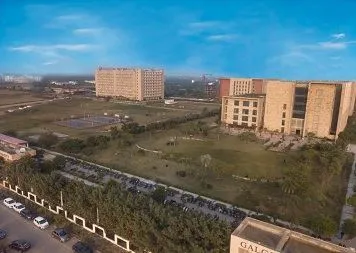
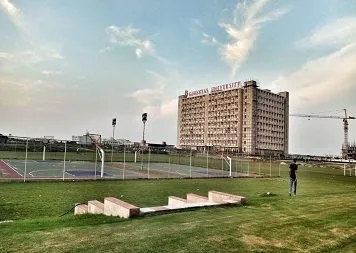
This is a privately run university in Gautam Buddha Nagar, at Plot No. 2, Sector 17-A, Yamuna Expressway, Opposite Buddha International Circuit, Greater Noida, Uttar Pradesh 203201.
Every programme on its fee sheet sits under one of its own schools rather than under an affiliated college, and the spread runs wider than the engineering reputation suggests. There is no medical college and no MBBS: the name is absent from the National Medical Commission's UG seat matrix for 2024-25. What the fee sheet carries instead is a long allied-health list, with nursing and pharmacy sitting beside Bachelor In Medical Radiology and Imaging Technology, Bachelor of Cardiovascular Technology, Bachelor In Anaesthesia and Operation Theatre Technology, Bachelor of Emergency Medical Technology, Bachelor of Optometry and Master of Physiotherapy.
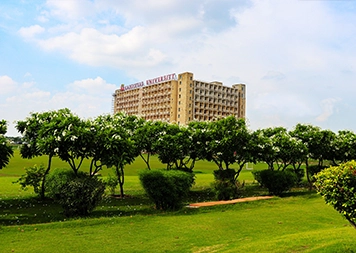
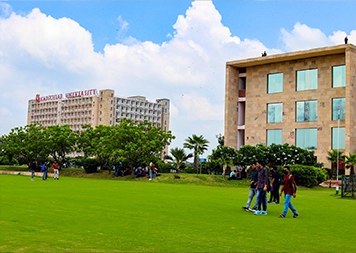
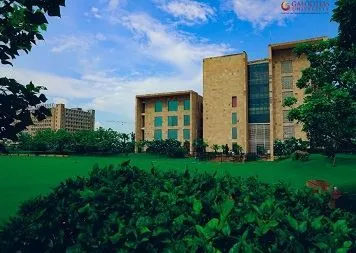
The lineage claimed is old and the university is not. It traces itself to the Galgotias Education Group which was established in 1933, while recording that the first batch of students was admitted in July 2011, growing since to more than 25,000 students on a 52-acre campus drawing from 28 states. Its own filings show how out-of-state that is: across the five-year law programmes it counts 176 students from within Uttar Pradesh against 874 from outside the state.
How easily the names blur shows up on the university's own site. Its placement page runs a Cognizant letter thanking all the students of the 2015 batch of Galgotia's College of Engineering and Technology, which is a separate institution under the same family name. Galgotias Institute of Management and Technology is a third. If the university's own recruiter wall mixes them, read the source line on any Galgotias number before you carry it into a shortlist.
Courses & Fees
Tuition is published per programme, per year, with the same four side charges attached to nearly every course. The eight rows students ask about most read as follows on that sheet.
| Programme | Duration | Tuition per annum | Class 12 or degree bar |
|---|---|---|---|
| B.Tech Computer Science and Engineering | 4 Years | Rs 1,64,000 | 60% in PCM or allied subjects |
| Bachelor of Pharmacy | 4 Years | Rs 1,40,000 | 60% with Physics and Chemistry compulsory |
| B.Sc in Nursing | 4 Years | Rs 1,51,000 | 55% with PCB and English |
| Integrated BA + LL.B (Hons) | 5 Years | Rs 1,19,000 | 55% aggregate |
| Integrated BBA + LL.B (Hons) | 5 Years | Rs 1,19,000 | 50% aggregate |
| Bachelor of Laws (LL.B.) (Hons.) | 3 Years | Rs 65,000 | 50% in graduation, or 45% with a CUET, CLAT or AILET score |
| MBA with Dual Specialization | 2 Years | Rs 1,64,000 | 55% in graduation |
| M.Tech Computer Science and Engineering | 2 Years | Rs 90,000 | 50% in a CS or IT B.E, B.Tech, MCA or M.Sc |
Every figure and every percentage above is taken from the Fee Structure and Eligibility page.
On top of tuition, the same sheet adds an exam fee of Rs 20,000, accidental insurance of Rs 650, one-time caution money of 2000 and a student ID card charge of 1000 to almost every programme. Nursing carries one extra head that engineering does not, a clinical training fee of Rs 25,000 per annum, so its real annual cost sits above the tuition line in the table.
The branded versions of a programme are where the gap opens up. Plain B.Tech Computer Science and Engineering is Rs 1,64,000 a year; B.Tech in Computer Science and Engineering specialisation in Artificial Intelligence & Machine Learning In collaboration with - Microsoft & byteXL is Rs 2,50,000. The floor of the whole sheet is a one-month Yoga Instructor Course at Rs 5,000; among full degrees it starts at a Bachelor of Vocation at Rs 25,000 and the highest rupee line is the M.A Journalism and Mass Communication with India Today Media Institute at Rs 2,57,500. The M.Tech routes run with YNOV break the rupee comparison entirely, because they are quoted in two currencies and in two different shapes. Taught wholly on this campus they read INR 90000/- (GU) + € 2500 (YNOV); move the second year to the YNOV campus and the same degree reads INR 90000/- (1st Year in GU) & € 9000 (2nd Year in YNOV). Convert the euro leg before you set either against a plain M.Tech.
Admissions
Registration is online or at the campus office, and the university charges an application fee of Rs 1,200 (non-refundable) after email verification. Selection is then stated plainly as merit-based selection according to eligibility criteria, followed by in-person document verification with originals before the provisional offer becomes an admission.
Only a defined list of programmes sits an entrance test at all.
| School | Programme | Entrance requirement |
|---|---|---|
| Allied Health Sciences | Master of Physiotherapy, all specializations | GU Entrance Exam |
| Allied Health Sciences | Masters in optometry | GU Entrance Exam |
| Allied Health Sciences | M.Sc in Cardiovascular Technology | GU Entrance Exam |
| Allied Health Sciences | M.Sc in Medical Laboratory Technology | GU Entrance Exam |
| Nursing | B.Sc in Nursing | GU Entrance Exam, NEET or CNET (ABVMU) |
| Law | LLM, all specializations | GU Entrance / CLAT / CUET (Preference given) |
| PhD | All specializations | GU Entrance Exam or UGC-NET/JRF |
The table is reproduced from the Program-Specific Entrance Exam Requirements block on the admission procedure page.
Read the law rows carefully, because this is where applicants most often assume wrong. The five-year integrated degrees are not on that list, and the fee sheet states their condition as marks plus a preference: an applicant with a valid score in AILET, CLAT, CUET or SAT will be given preference in Merit. For those five years CLAT is a tie-breaker, not a gate. The three-year LL.B. is the exception worth knowing, because there a valid CUET, CLAT or AILET score lowers the graduation bar from 50% to 45%, and the LL.M names CLAT as one of three accepted tests.
The same logic runs through the rest of the catalogue, where national scores appear as other accepted national level exams, preference in merit list: CUET at both UG and PG level, JEE Main and Advanced for B.Tech, MAT, XAT, CMAT, NMAT and GMAT for MBA, UCEED for design, GATE for M.Tech, NEET for nursing and SAT for undergraduate entry. Hold none of them, clear the percentage bar, and you are still in the merit pool.
One published step deserves a plain reading. If you are not selected, the next stage is an Interview with admission counsellor for alternative options, so a rejected application is routed toward a different programme rather than closed. Decide in advance which alternatives you would accept.
Cutoff
The bar here is not one number, and two versions of the same five-year law degree show it: BBA + LL.B asks 50% in Class 12 while BA + LL.B asks 55%, for the same duration at the same Rs 1,19,000 a year. Engineering and pharmacy both sit at 60% in the relevant Class 12 subjects, and nursing at 55% across Physics, Chemistry, Biology and English.
Past those floors there is nothing to look up. The published route ends in a merit list the university draws itself and a document check at its own admission office, so no closing mark or rank is generated for any branch or any category. Among the undergraduate routes B.Sc Nursing is the only one where an outside test can qualify you rather than merely lift you up the list, through NEET or the ABVMU-run CNET.
Money is where the sharper thresholds sit. A fee waiver turns on a JEE rank up to 25000th or, for law, a minimum 100 score in CLAT. Miss them and your bill changes, not your odds of a seat, which is the reverse of how a public counselling cutoff behaves.
Placements
The bluntest number in the government filings is a zero: the B.Pharm cohort that finished in 2021-22 had 91 students complete on time and 0 placed. The returns filed with the National Institutional Ranking Framework are worth reading first for exactly that reason: they tie a number to a cohort you can count.
| 2023-24 cohort filed with NIRF | Graduated in minimum time | Placed | Median salary |
|---|---|---|---|
| Engineering, 4-year B.Tech | 1087 | 770 | Rs 4,95,000 |
| Engineering, 2-year M.Tech | 24 | 19 | Rs 7,40,000 |
| Law, 5-year programmes | 198 | 185 | Rs 6,40,000 |
| Law, 3-year LL.B | 34 | 31 | Rs 6,20,000 |
| Law, 1-year PG | 39 | 35 | Rs 7,40,000 |
| Pharmacy, 4-year B.Pharm | 83 | 31 | Rs 4,27,000 |
| Pharmacy, 2-year PG | 15 | 12 | Rs 7,24,000 |
Rows are from the placement blocks of IR-E-U-0643, IR-L-U-0643 and IR-P-U-0643, three of the returns Galgotias filed for NIRF 2025. The engineering return is the one to find first, because it covers the largest cohort on this campus and nothing above it does the summarising for you: engineering is a rank-band placing rather than a ranked one, so NIRF publishes no score beside it and that data sheet is the whole of the public record.
Engineering is the row most readers of this page are actually buying. Its 2023-24 B.Tech line, 1087 graduating on time and 770 placed, works out at about seven graduates in ten, and the median of Rs 4,95,000 is the number a typical B.Tech student here should plan against. Two years earlier the same programme filed 934 graduates and 552 placed on a median of 400000, so the direction is up on both counts.
The law line has moved fast in three years: a median of 300000 in 2021-22, then 350000 in 2022-23, then 640000 in 2023-24 for five-year graduates, on a placed share that rose with it from 71 of 84 to 131 of 166 to 185 of 198. More students, better pay and better odds, all three at once.
Pharmacy has not recovered on the same scale. The two years after the blank one reached only 33 of 85 and then 31 of 83, so a B.Pharm applicant is reading a filed record in which fewer than two graduates in five were placed in the best of the three years.
The university's own account is not denominated that way. Its home page advertises 1250 organizations recruited, a 60 LPA highest package for the year 2026 and a 5.4 LPA average package, and the FAQ under it adds 5500+ total offers, 1200+ recruiting organizations, 750+ offers above 6 LPA. The highest package is the only one of the six that names a year. The recruiter counts, the average and the three FAQ totals name none, so there is no cohort to set any of them against.
The company-wise lists are the part of the same page that can be pinned to a cycle. The 2025-26 list ends at serial 603, the 2024-25 list at 838 and the file it dates 2023-24, headed 2024 Batch, at 941, with some names repeating inside a single list. Treat each as a single-cycle count rather than a running total. The serial numbers themselves run straight through in all three files, but the ordering does not: only the 2025-26 sheet is sorted by hire count from the top of the file to the bottom. The two older ones group rows into discipline blocks, B.Tech first and the other degrees after, and restart the descending count inside each block, so a row far down one of those files can still be a bulk hirer for the discipline it sits in.
Those lists also show how concentrated the hiring is. The top four rows for 2025-26 are Infosys with 526 placed students, Capgemini with 228, Cognizant with 205 and City Union Bank Limited with 188, against a long tail of firms taking one graduate each; a year earlier Infosys took 159. Mass hiring by one or two service companies is what moves the total, and that is a different proposition from the 60 LPA headline.
Seat Matrix
The intake numbers exist, but they are grouped by how many years a programme runs rather than by branch, and they are split across three separate NIRF returns rather than published in one place.
| Sanctioned intake filed with NIRF | 2023-24 | 2022-23 | 2021-22 | 2020-21 |
|---|---|---|---|---|
| Engineering, UG 4-year | 3615 | 2730 | 2115 | 1054 |
| Engineering, PG 2-year | 47 | 38 | Not filed | Not filed |
| Law, UG 3-year | 60 | 60 | 60 | Not filed |
| Law, UG 5-year | 360 | 240 | 240 | 240 |
| Law, PG 1-year | 40 | Not filed | Not filed | Not filed |
| Pharmacy, UG 4-year | 100 | 100 | 100 | 100 |
| Pharmacy, PG 2-year | 45 | 45 | Not filed | Not filed |
Every figure above is the approved-intake line of one of the three Galgotias returns for NIRF 2025, engineering, law and pharmacy; a dash in the original is shown here as not filed.
Growth is the story in the top two rows and absent from the bottom one. Engineering seats went from 1054 to 3615 in three filed years, more than tripling; five-year law seats jumped by half in one, from 240 to 360; B.Pharm has not moved off 100 in four. Weigh the strong law medians above against that middle line: the students who produced them entered when the class was two thirds its current size.
What none of these reaches is intake per branch. The fee sheet prices every engineering specialisation separately without saying how many seats any one of them carries, and the NIRF return counts all four-year engineering programmes as a single figure. There is no AICTE record to fall back on either, because the approvals page takes the position that AICTE approval unnecessary for university technical courses by Supreme Court, and the university is accordingly absent from AICTE's approved-institution list while the engineering college and the management institute of the same family name are on it. Ask the admission office for the branch intake on letterhead before you accept a seat in a named specialisation.
Rankings
Seven NIRF 2025 tables carry this university and only two of them give it a number, which is the distinction to hold on to before comparing it with anything. It is 36th in Law with a score of 53.33 and 55th in Pharmacy with 50.66. The other five are rank-bands, published as an alphabetical list with no score and no position inside the range, and the one most likely to be missed is also the strongest: NIRF's innovation table puts Galgotias in the 11-50 band, ahead of anything it holds elsewhere. Engineering is banded at 101-150. Management is banded at 101-125. The all-university table bands it at 101-150 too. The overall table, the deepest of the seven, places it at 151-200. A band is a real placing and should not be read as an absence, but it fixes only a ceiling and a floor. Two further tables record the university as a participant with no placing at all, the Agriculture and Allied Sectors list and the SDG institutions list.
Parameter scores exist only for the two ranked tables, so this is the whole of what NIRF grades this university on.
| NIRF 2025 parameter | Law | Pharmacy |
|---|---|---|
| Teaching, Learning and Resources | 64.93 | 70.05 |
| Research and Professional Practice | 32.50 | 40.82 |
| Graduation Outcomes | 59.89 | 46.13 |
| Outreach and Inclusivity | 75.16 | 71.89 |
| Perception | 0.00 | 9.68 |
| Total | 53.33 | 50.66 |
The two columns are separate submissions filed under the same institute number, IR-L-U-0643 for law and IR-P-U-0643 for pharmacy, so each is scored only against the schools in its own discipline.
The law column holds the highest and the lowest numbers on the page at once. Outreach and inclusivity at 75.16 is the school's strongest parameter anywhere, and perception is 0.00, the floor of the scale. Perception is scored from what academics, employers and the public say about a school, so a rank of 36 built on a zero there tells you the outcome numbers are carrying the placing on their own.
Direction matters as much as position. Pharmacy was 50th in 2024 on a score of 50.73 and its 2025 score of 50.66 is almost the same number, so the five places it slipped came from the field improving around it rather than from the school going backwards. Law has no such comparison: the university does not appear anywhere in the NIRF 2024 law list of 39 ranked institutions.
Everything else on the university's own ranking wall comes from bodies outside NIRF and is quoted there by the university itself: a 4-star overall rating and a 5-star distinction in Teaching, Academic Development, Facilities, Employability and Innovation by QS Stars, 9th in India and 2nd in UP in the India Today MDRA 2023 rankings for Private Universities, and the law school 4th in the North Zone and 21st in all of India by BW Legal World's Top Indian Law Schools 2023.
Departments
Every programme belongs to a named in-house school, and the list runs long enough that the engineering identity is only part of it: School of Computer Science and Engineering, School of Artificial Intelligence, School of Engineering, School of Business, School of Computer Applications and Technology, School of Law, School of Defence Technology, School of Aviation, Logistics and Tourism Management, School of Skill Sciences and Entrepreneurship, School of Finance and Commerce, School of Media and Communication Studies, School of Medical and Allied Sciences, School of Nursing, School of Allied Health Sciences, School of Agriculture, School of Design, School of Biosciences and Technology, School of Hospitality, School of Liberal Education, School of Languages, School of Basic Sciences, Galgotias Polytechnic, School of Education, School of Vocational Education and School of Forensic Sciences.
Two of those are unusual for a private university in the National Capital Region and worth a look if they match your interest: the School of Forensic Sciences, which prices standalone certificate work in Advanced crime scene management, Forensic photography, Graphology and personality profiling and Social Media Crimes, and the School of Defence Technology. A polytechnic sitting under the same registration as a law school is the other thing to notice, because it means the campus mixes diploma and doctoral cohorts.
Facilities & Infrastructure
The campus is built around named industry centres rather than generic labs, among them the Apple iOS Development Centre, an IBM Centre of Excellence, a Cisco Centre of Excellence, the L&T Advanced EV Centre of Excellence, a Microchip Centre of Excellence and the Galgotias Semiconductor Research Lab. Those are partnerships, so ask which of them your own programme actually timetables into.
Lab and library spending is the part of that claim you can audit, because each NIRF return declares it. Engineering is where the money goes: new equipment and software for laboratories was 100961545 rupees in 2023-24 against 34355906 two years earlier, with engineering workshops taking a further 9974446. The pharmacy return moved in the same direction on a much smaller base, 12488453 rupees on lab equipment in 2023-24 against 4730241 the year before. The law unit's library line rose more steadily, from 2673938 rupees in 2021-22 to 5268159 in 2023-24.
For a disabled student the useful line is in the filing rather than the brochure, where the university answers yes to walking aids, wheelchairs and transport from one building to another, and puts ramp, lift and accessible-toilet coverage at more than 80%.
Hostel
Residence is the number that shapes a decision here, and it is lopsided. The hostel page states a capacity of 1,400 seats in Boys Hostel and 280+ seats in Girls Hostel, roughly five male beds for every female one on a campus that admits both.
Pricing compounds it. A boy pays Rs 1,71,000 per annum for a twin occupancy AC room and Rs 1,60,000 for non-AC; a girl pays exactly the same Rs 1,71,000 for AC and Rs 1,60,000 for non-AC but in triple occupancy with an attached washroom. The AC room therefore costs more than a year of B.Tech tuition, Rs 1,71,000 against Rs 1,64,000, so hostel plus tuition is the figure to carry into any comparison.
Two details soften that. Mess charges are included in Hostel fee, which is not standard, and the dining is run in collaboration with Sodexo with a fully air-conditioned hall and 4 elevators/lifts installed. Rooms are allotted only after payment at the admission or accounts office, so a hostel seat is not reserved by the admission offer itself.
Faculty
Faculty strength is published one NIRF return at a time, and the three that exist are wildly different in size. The engineering submission enters 581 faculty members, the law submission 77 and the pharmacy submission 39. Nursing, design and the allied health sciences have no NIRF category to file into at all, so for those schools the only way to a headcount is to ask the department.
Doctoral supervision follows the same shape. Engineering reports 99 full-time and 123 part-time PhD students, law 27 and 30, pharmacy 25 and 19. Completions have accelerated across all three: law awarded 11 full-time doctorates in 2023-24 against 1 two years earlier, pharmacy went from 1 to 7, and engineering from 6 to 28 over the same span.
Funded research is where the three separate sharply, and it is worth knowing before you pick a supervisor. Engineering filed 62 sponsored projects worth 11811250 rupees in 2023-24 and 37 consultancy projects on top. The law unit filed 0 sponsored projects in both 2023-24 and 2022-23, after 17 projects worth 2342960 rupees in 2021-22; consultancy carried it instead, at 10 projects worth 1764100 rupees in 2023-24. Pharmacy filed 0 sponsored projects and zero consultancy across all three years.
Notable Alumni
No alumnus of this university has a public record traceable to a primary source, which is roughly what a first intake of July 2011 implies: the oldest cohorts are barely a decade into their careers. The university's Alumni Connect link does not lead to a named-alumni page either; it opens an external Galgotias Alumni Network sign-in portal that covers the engineering college as well as the university. That shared portal is also why a famous Galgotias alumnus quoted anywhere else is worth tracing to the engineering college first.
News & Articles
The announcements worth an applicant's attention are the ones that change who teaches or what is taught. The university reports that Professor Saumya Sindhwani of Indian School of Business (ISB) Appointed Provost of Galgotias University, and that The Hindu Group and Galgotias University Bring Newsroom Learning to Greater Noida Campus Through New Journalism Excellence Centre, which is the partnership behind the Certificate Course in Journalism (In Collaboration with The Hindu Group) on the fee sheet.
Student results are reported alongside them, including 18 Galgotias University Students Won Apple's Swift Student Challenge 2026 and a rise in the Times Higher Education (THE) World Rankings 2026. Its examination notices, which matter more once you are enrolled, are posted on the same page.
College Compare
The two ranked NIRF tables put this university in very different company, and the law placing is the tighter contest. At 53.33 it sits between National Law University and Judicial Academy on 53.39 and Army Institute of Law on 53.27, a spread of twelve hundredths of a point across three names, so the ordering could reverse in one edition. The interesting part is how differently those totals are built: Army Institute of Law scores 36.06 on perception where Galgotias scores 0.00, and Galgotias makes it back on research at 32.50 against 18.88.
In pharmacy the nearest comparison is local. Galgotias is 55th on 50.66 and Sharda University, also in Greater Noida, is 57th on 49.99, two places apart, but Sharda scores 55.29 on research against Galgotias' 40.82 while Galgotias leads on graduation outcomes, 46.13 against 38.15. If you are choosing between the two for a B.Pharm, those two parameters are the choice.
Contact & Location
The teaching campus is at Plot No. 2, Sector 17-A, Yamuna Expressway, Greater Noida, Uttar Pradesh 203201, opposite the Buddha International Circuit, with a Delhi NCR liaison office at C-56/38, Sector 62, Noida, Uttar Pradesh 201309 for applicants who cannot reach the Yamuna Expressway campus.
| Purpose | Published contact |
|---|---|
| National admission office | +91-9810162221, +91-9717300418, +91-9582847072 |
| Landline | 0120-4370000 |
| 9717300343 | |
| Admissions email | admission@galgotiasuniversity.edu.in |
| International admissions | +91-7838141101, +91-9899351883 |
Every line above is published on the admission helpline page. None of them reaches the office that holds records. For a corrected mark sheet, a migration certificate or a degree verification, the mandatory-disclosures page names the registrar and a separate direct line, Dr. Nitin Kumar Gaur, 0120-4806806, Registrar@galgotiasuniversity.edu.in.
Verified
Approvals & Accreditation
Statutory approvals and accreditation grades from official bodies.
The university states its own NAAC position in one line on its home page: it has been awarded a NAAC A+ grade. That is an institution-level grade, and it is the strongest single accreditation signal here.
Below it, approvals are programme-specific and come from the regulator that governs each field. The approvals page lists recognition or approval from UGC, NAAC, the Association of Indian Universities, the Bar Council of India, the Pharmacy Council of India, the Indian Nursing Council and the National Council for Teacher Education, and records that the School of Business is a member of AACSB. The pharmacy degree carries a second layer: the fee sheet describes it as Bachelor of Pharmacy (Approved by Pharmacy Council of India and Accredited by NBA).
The approvals page prints those names without a date beside any of them, which makes it the wrong page to read. The mandatory-disclosures page posts the letters themselves, and their titles carry the years: INC Approval-2025-2026, PCI Approval Letter 2025-2026 and Bar Council Of India_(BCI)_2026-27. Nursing and pharmacy clearance is granted a session at a time, so check that the year on the letter covers the year you would be joining.
Aid
Scholarships
Waivers here are automatic on marks and generous at the top. The academic ladder pays 100% tuition fee waiver to the topper of all central and state Boards, 25% for 95% or above in class 12th and 15% for 90 to 94.99%, with graduation-based slabs of 25% for 90% or above and 15% for 80 to 89.99%. Two programmes are carved out of the Class 12 slabs: the 25% and 15% awards apply except B.Pharm and B.Sc Nursing Program.
Entrance scores pay separately, and the rates say which exam the university values. A JEE rank up to 25000th earns 50%, while the management and law routes pay 20% for a minimum 60 percentile in CAT or above 600 marks in MAT, 20% for meritorious LSAT qualified students and 20% for a minimum 100 score in CLAT. CUET, the one national score this university accepts across almost every programme, is worth 5%.
The category awards are deeper than the merit ones in places. Residents of Jammu and Kashmir get 50% in the 1st year. Defence and central armed police aid runs by category, 50% on tuition fee for gallantry award recipients, 30% for serving officers on study leave, 30% for dependents of gallantry award recipients and 20% for dependents of serving or retired personnel. Coast Guard support goes furthest: dependents of personnel who died in harness are offered a 100% Programme Fee Waiver (excluding Examination Fee) across 10 Seats Annually, and both that award and the 5 Seats Annually reserved for dependents of personnel who suffered at least 50% disability during service need a recommendation from Coast Guard headquarters and exclude nursing and pharmacy. The published table prints no waiver percentage against that second category at all, so ask for it in writing before you count on it. NCC cadets get 15% for a B certificate and 20% for a C certificate, an orphaned student 50%, and a single-parent household with income at or under Rs 4 lacs, 15%.
The renewal clause is where most of this money quietly stops. Continuation requires a student to maintain a CGPA of 9.0 or above, with no backlog of carry-over papers and a minimum attendance of 75%, and the continued award is fixed at 10% for the following years. A 9.0 CGPA is a distinction-level result sustained every semester, so a first-year waiver should be budgeted as a one-year discount unless you are confident of holding that grade.
Decide
Compare with similar colleges
Voices
Student Reviews
Campus
Gallery

Questions
Frequently asked questions
References
Sources
- Official website – galgotiasuniversity.edu.in
- UG seat matrix for 2024-25 – nmc.org.in
- NIRF 2025 ranking – nirfindia.org
- Galgotias College of Engineering and Technology sits at Plot no. 1, Knowledge Park -II, Greater Noida, G.B. Nagar, U.P. 201310 – galgotiacollege.edu
At a glance
Quick facts
- Established
- 2011
- NIRF 2025 (Law)
- Rank #36NIRF· 2025-08-14
- NAAC
- A+, CGPA 3.37
- Website
- galgotiasuniversity.edu.in

Expertie Editorial Team
This page is researched and maintained by the Expertie editorial team, and checked against official sources.
Found something that looks wrong? Email us at editorial@expertie.com.
Last updated