

Homi Bhabha National Institute, Mumbai
The Homi Bhabha National Institute is a university you cannot walk into. It has no single teaching campus, no undergraduate college of its own, and no common entrance test that admits you to "HBNI." What it has instead is a federation: ten research laboratories and two cancer-care institutions run by the Department of Atomic Energy, whose degrees are all awarded under one deemed-university umbrella headquartered at Anushaktinagar in Mumbai. HBNI placed 7th among the country's research institutions in the 2025 National Institutional Ranking Framework, which tells you the substance is real even if the structure is unusual. This page explains what that structure means for a student deciding whether, and how, to study here.
Overview
HBNI was set up in 2005 as a deemed-to-be university under Section 3 of the University Grants Commission Act, and it is an aided institution of the Department of Atomic Energy rather than a stand-alone college with its own faculty and lecture halls. Think of it as a degree-awarding shell wrapped around institutions that already existed and were already doing serious work. The Bhabha Atomic Research Centre in Mumbai had been training nuclear scientists for decades, and the Tata Memorial Centre had been treating cancer patients for generations, before HBNI came along to certify their teaching. HBNI's job is to give the science and the clinical training done at these places the academic recognition of a PhD, an MTech, or an MD, under a single, nationally accredited name.
That design answers the two questions searchers ask most often about it. HBNI is a government institution, fully funded through the atomic-energy budget, not a private university. And it is a different body from "Dr. Homi Bhabha State University" in Mumbai and the various Dr. Homi Bhabha colleges around the country, all of which share the physicist's name but none of which are connected to the atomic-energy establishment. If your interest is nuclear science, physics, cancer medicine, or mathematics done inside a national laboratory, HBNI is the one you mean.
Courses & Fees
Almost everything HBNI awards is a postgraduate or doctoral degree. The core offering is the PhD, taught across the sciences, engineering, and medicine, and structured in two parts: a year of graded coursework followed by research that produces a thesis. Around it sit master's-level and specialist degrees, plus a small number of longer integrated programmes that admit younger students.
| Programme | Level | Where it is taught |
|---|---|---|
| PhD | Doctoral | Every constituent institution |
| MTech | Postgraduate | BARC training schools and select labs |
| MSc | Postgraduate | Physics, chemistry, and life-science labs |
| MD, DM, MCh | Postgraduate and super-speciality medicine | Tata Memorial Centre, Mumbai |
| PG Diploma | Post-graduate diploma | BARC training schools |
| Integrated MSc (5-year) | After Class 12 | National Institute of Science Education and Research, Bhubaneswar |
| Integrated PhD | After a bachelor's degree | Physics and chemistry institutes |
On money, HBNI works the opposite way to a self-financed private university: most people here are paid to study rather than charged tuition. Research scholars draw a monthly fellowship from the laboratory that hosts them, and trainees who enter through the atomic-energy schemes receive a stipend during their course before moving into a salaried scientist post. The one place where conventional fees apply is medical education at the Tata Memorial Centre, where MD, DM, and MCh seats carry course fees set and published by the hospital. Because each constituent institution runs its own admissions, the exact fellowship amount and any nominal registration fee are published on that institution's own admissions page rather than centrally by HBNI.
Admissions
There is no "apply to HBNI" form. You apply to one of its constituent institutions, sit the national exam that institution uses, and the degree you eventually earn is an HBNI degree. Which exam depends entirely on the door you choose.
- Physics, chemistry, mathematics, and life-science research is reached through the Joint Entrance Screening Test (JEST), GATE, or the CSIR-UGC NET, followed by an interview at the specific laboratory.
- The nuclear-engineering and scientist track runs through the BARC training schools under the OCES and DGFS schemes. Candidates are shortlisted on a written examination or a GATE score and interviewed in Mumbai and Hyderabad; those who clear it join a one-year orientation course that can earn a PG Diploma and credits toward an MTech or PhD.
- The 5-year Integrated MSc at NISER Bhubaneswar, HBNI's off-campus centre, is the only route open straight after Class 12, and it is filled through the National Entrance Screening Test (NEST).
- Medical seats at the Tata Memorial Centre are filled through NEET-PG for MD places and NEET-SS for the DM and MCh super-specialities, with the standard split between all-India and state quotas.
The practical takeaway: decide the science first, then the institution, then the exam. Working backwards from "I want an HBNI degree" leads nowhere, because the institute does not admit at that level.
Cutoff
Because admissions are decentralised, HBNI never publishes one cutoff or one closing rank. The bar you have to clear is the bar of the exam and the laboratory you are aiming at. A PhD aspirant at a physics institute is judged on a JEST score and an interview panel's assessment; an engineering graduate entering through OCES is ranked on the training-school examination; a doctor seeking an MD at the Tata Memorial Centre is placed by an all-India NEET-PG rank. These thresholds move every cycle with the number of seats, the strength of the applicant pool, and the reservation roster, so the only reliable cutoff is the one each constituent institution posts against its own current advertisement.
Placements
A trainee who enters through the BARC schemes gets the rarest thing in Indian higher education: a job fixed before the degree is finished. Candidates who clear the OCES or DGFS route and complete the course are appointed scientific officers within the Department of Atomic Energy, so for that cohort the open question is which laboratory they join, not whether work follows. HBNI itself runs no placement cell and quotes no package, because the destination for most of its students is decided by the route they entered through rather than by a recruitment season. PhD scholars move into faculty positions, postdoctoral research in India and abroad, and scientist roles across the DAE laboratories and other national institutions. Medical graduates of the Tata Memorial Centre carry one of the most respected oncology qualifications in the country into clinical practice and academic medicine. If your yardstick is a corporate salary figure at graduation, this is the wrong institution; if it is a life in research or specialist medicine, the pipeline is direct and well established.
Seat Matrix
There is no consolidated, category-wise seat matrix for HBNI as a whole, and any single number claiming to be one should be treated with suspicion. Intake is fixed programme by programme, institution by institution, and only for the cycle in question: a physics laboratory may take a handful of JEST-selected PhD scholars, the BARC schools admit a larger annual cohort of trainee scientific officers, and the Tata Memorial Centre's MD and super-speciality seats are notified against NEET counselling each year. The authoritative count for any programme is the seat figure in that constituent institution's current admission notification.
Rankings
HBNI's rankings say something specific about it: it is measured as a research powerhouse first and a broad university second. In the 2025 National Institutional Ranking Framework it sits 7th in the Research category, ahead of many far more famous names, and 12th among universities, while its combined Overall position sits a good deal lower down the table.
That gap is the interesting part. HBNI scores heavily on research output and graduation outcomes but modestly on the public-perception measure that also feeds the Overall list, which is exactly what you would expect from an institution the wider public has barely heard of even though its laboratories rank among the country's best. For a prospective scholar, the research standing is the figure that matters, and it is the one HBNI earns on merit.
Departments
HBNI's academic map is drawn by its constituent institutions, each of which contributes a discipline or two. Rather than a set of departments in one building, it is a country-wide spread of specialist centres, and knowing which institution owns which subject is how you navigate it.
| Constituent institution | City | Main disciplines |
|---|---|---|
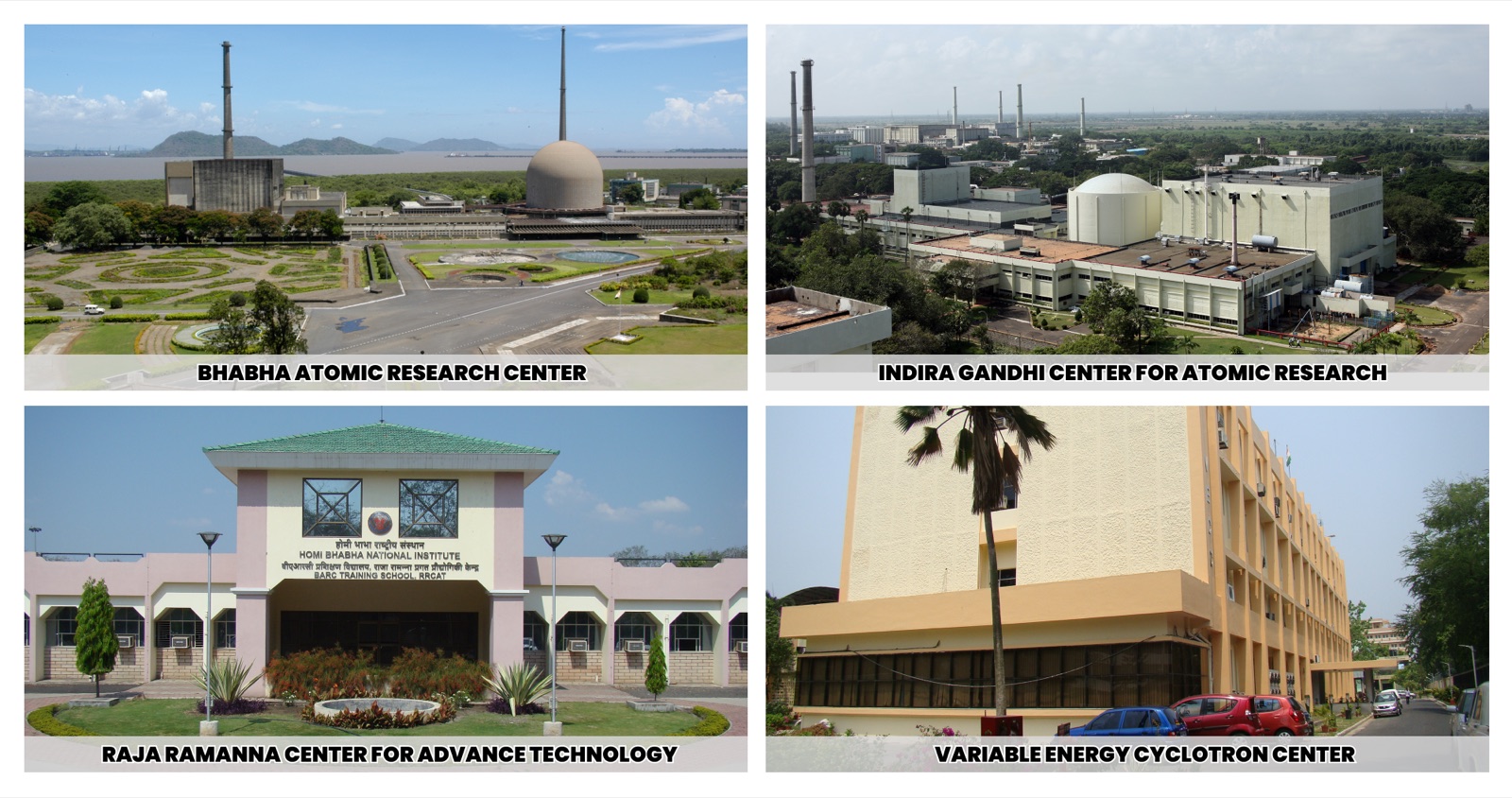
| Bhabha Atomic Research Centre | Mumbai | Nuclear science and engineering |
| Indira Gandhi Centre for Atomic Research | Kalpakkam | Fast-reactor and materials research |
| Raja Ramanna Centre for Advanced Technology | Indore | Lasers and accelerator physics |
| Variable Energy Cyclotron Centre | Kolkata | Nuclear and accelerator physics |
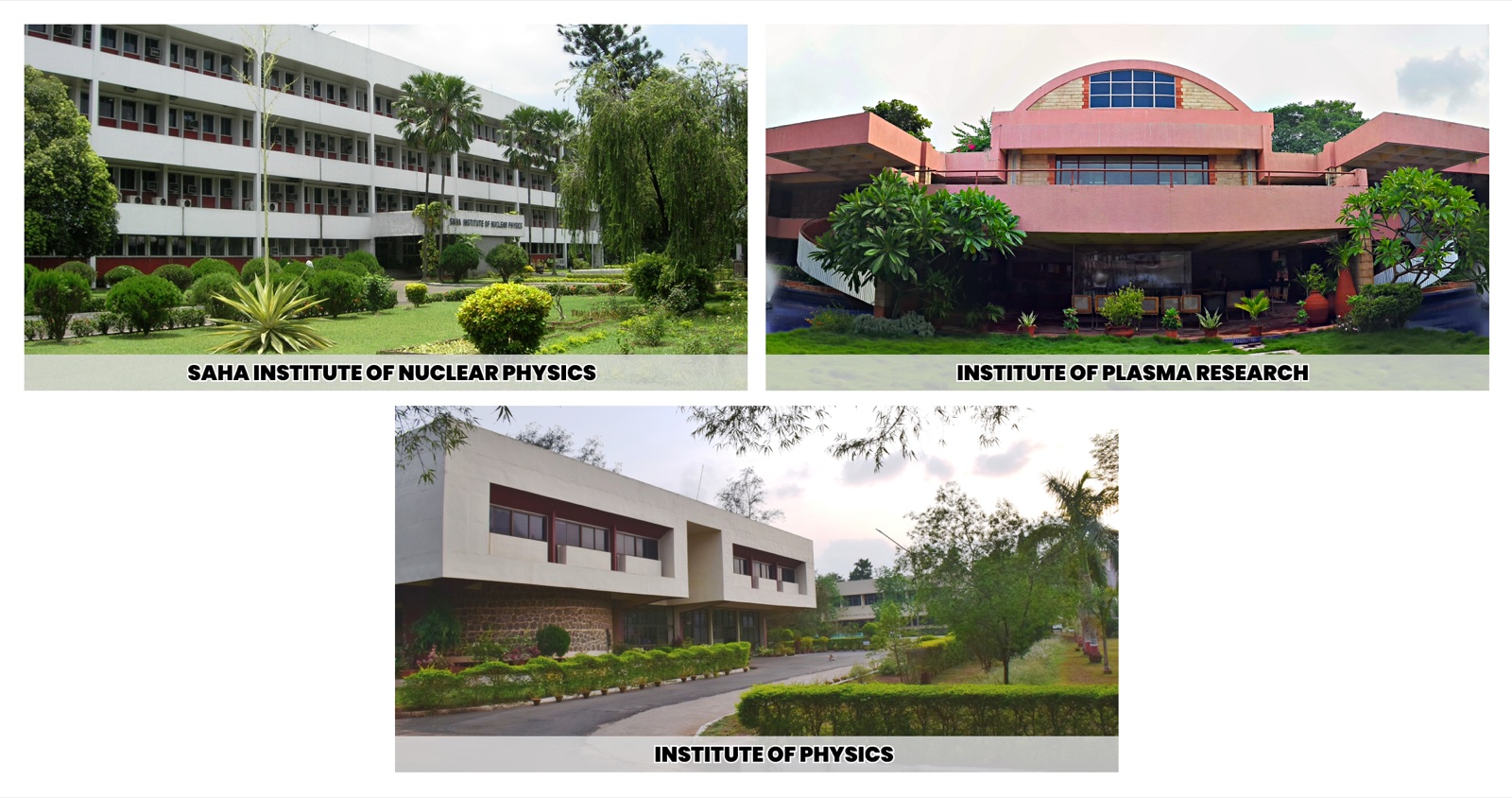
| Saha Institute of Nuclear Physics | Kolkata | Physics and biophysical sciences |
| Institute for Plasma Research | Gandhinagar | Plasma and fusion research |
| Institute of Physics | Bhubaneswar | Theoretical and experimental physics |
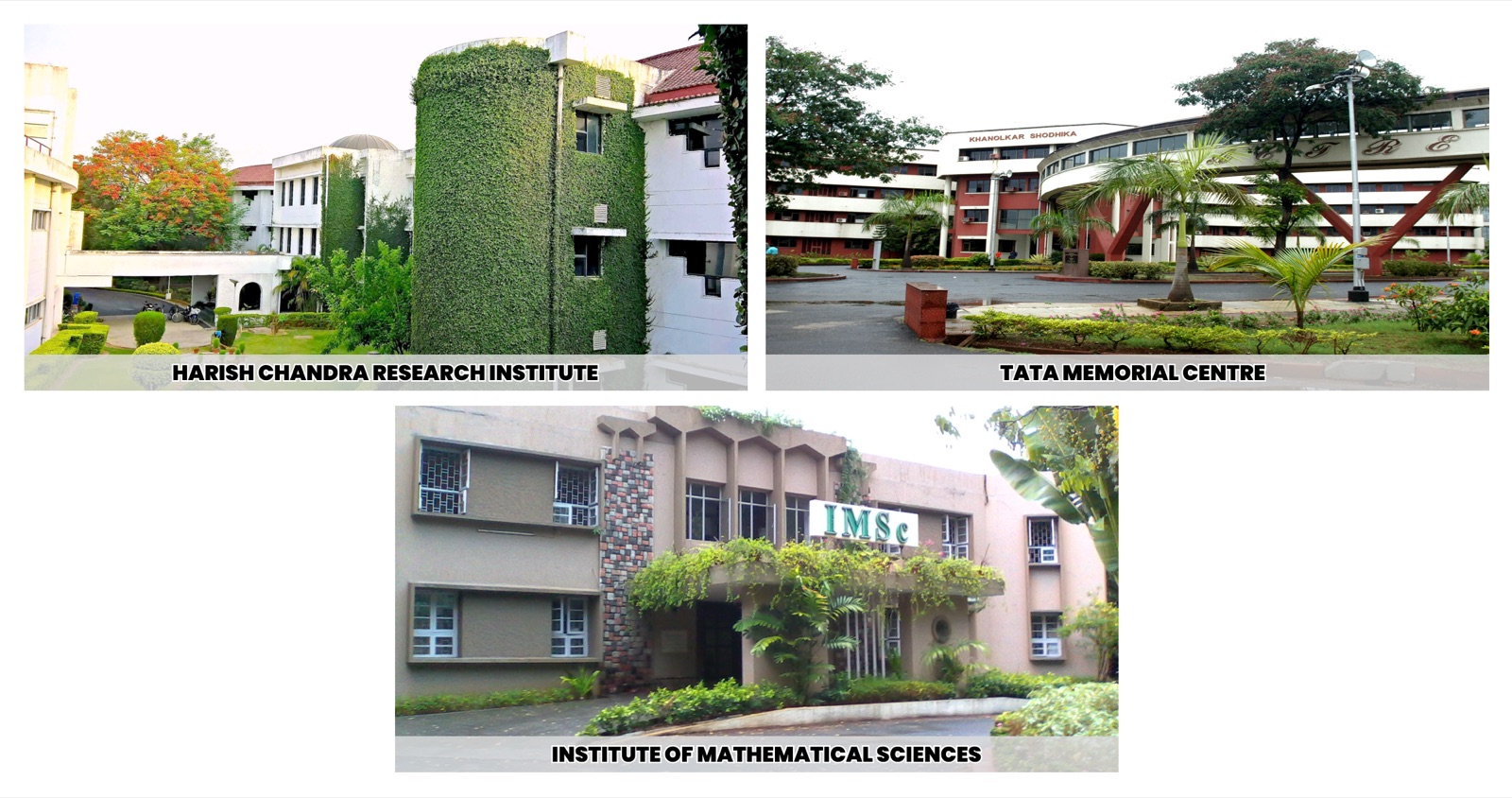
| Harish-Chandra Research Institute | Prayagraj | Mathematics and theoretical physics |
| Institute of Mathematical Sciences | Chennai | Mathematics and computer science |
| Tata Memorial Centre | Mumbai | Oncology and cancer research |
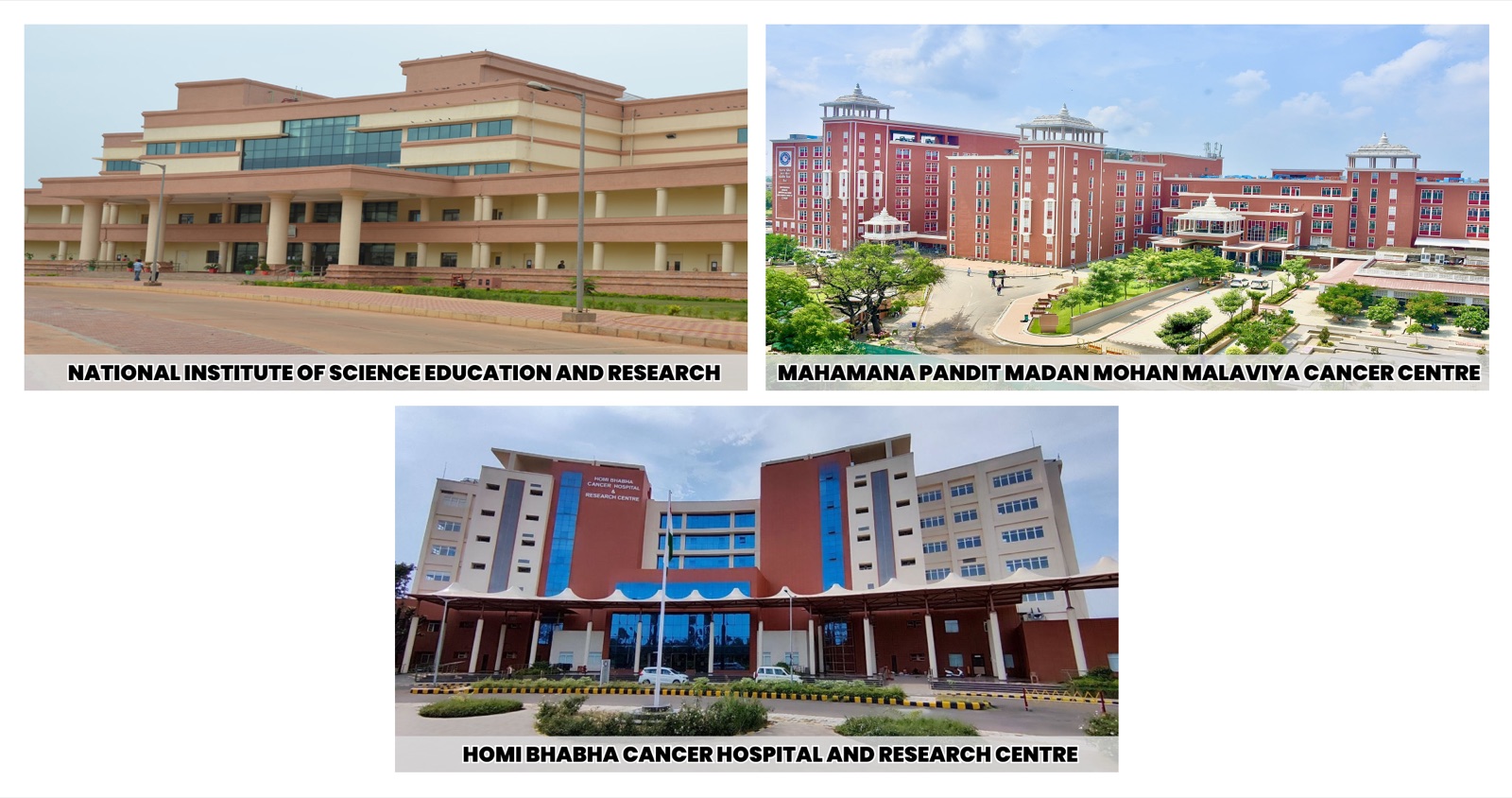
| National Institute of Science Education and Research | Bhubaneswar | Basic sciences, including undergraduate teaching |
| Homi Bhabha Cancer Hospital and MPMMC Centre | Varanasi | Cancer care and clinical research |
Alongside the sciences and medicine, HBNI has identified a Strategic Studies programme to build expertise on the legal, economic and security questions that surround nuclear technology, a discipline few universities cover at all.
Facilities & Infrastructure
The point of studying under HBNI is access to instruments that most universities cannot dream of owning. This is not a library-and-lecture-hall campus; it is the working floor of national laboratories. Depending on where you are placed, that can mean research reactors and hot cells at Kalpakkam, synchrotron and high-power laser facilities at Indore, a superconducting cyclotron at Kolkata, or the tokamak devices of the plasma-research institute at Gandhinagar. At the Tata Memorial Centre and its Kharghar research arm, ACTREC, it means clinical wards and cancer-biology laboratories in the same institution. The infrastructure is the reason the degree exists: HBNI formalises the education that already happens around these machines and clinics.
Hostel
Residential arrangements, like everything else here, belong to the constituent institution rather than to HBNI centrally. The atomic-energy training schemes are the clearest case: trainees who enter through the BARC schools are housed in departmental hostels for the duration of the orientation course, and staying in is part of the programme. Research scholars at the physics, chemistry, and mathematics institutes are typically offered campus accommodation as well, since these are residential research communities by design. For the exact hostel facilities, room arrangements, and any charges, the reliable source is the accommodation page of the specific institution you are joining.
Faculty
HBNI's faculty are not lecturers hired to teach; they are the working scientists, engineers, and clinicians of the laboratories and hospitals themselves. A PhD supervisor at one of the physics institutes is an active researcher running experiments; a clinical teacher at the Tata Memorial Centre is a practising oncologist. This is the trade at the heart of the model. You give up the campus-university experience of a fixed teaching department, and in exchange you are taught and mentored by people doing frontier work rather than by a separate teaching cadre. Formal academic oversight, degree standards, and thesis examination are coordinated centrally by HBNI, while the day-to-day mentoring happens at the bench.
Notable Alumni
We name individuals only when their association with a specific institution is documented, and because HBNI awards degrees on behalf of laboratories whose senior scientists often predate the university itself, that attribution is genuinely hard to make cleanly. What can be said accurately is the shape of the alumni body rather than a list of names: it is dominated by DAE scientific officers, research faculty across Indian institutions, and oncologists trained at the Tata Memorial Centre. Rather than publish an unverified roster of famous names, we leave this open and point you to each constituent institution's own alumni and faculty pages, where the record is traceable.
News & Articles
HBNI publishes its own official material rather than routing announcements through third parties, and that is where current information lives. Its website carries the annual academic reports, the NIRF submission data, admission advertisements from the constituent institutions, and periodic newsletters. Because admission calendars are set by each laboratory and by the national exams (JEST, GATE, NEET, NEST), the dates that matter to an applicant appear on those exam portals and on the relevant institution's notices rather than in a single HBNI bulletin. For anything time-sensitive, the official website is the primary source to check.
College Compare
Students weighing HBNI usually hold it against the Indian Institute of Science, the Tata Institute of Fundamental Research, or the research-heavy IITs, and the honest comparison turns on structure rather than prestige. IISc and TIFR are single-campus institutions you join directly; the IITs are engineering-led universities with large undergraduate populations. HBNI is neither. It is a distributed, mission-oriented university whose strength is concentrated in nuclear science, accelerator and plasma physics, mathematics, and cancer medicine, and whose entire undergraduate presence is one integrated MSc programme at NISER. If your field is one of those specialisms and you want to train inside a national laboratory, HBNI is difficult to match. The fairest way to weigh it against IISc, TIFR or an IIT is on their published NIRF standings and the specifics on each institution's page, because the four are built for genuinely different things and a single ranking column flattens that.
Contact & Location
HBNI's central office sits inside the atomic-energy campus at Anushaktinagar in the eastern suburbs of Mumbai, Maharashtra. Because it is a degree-awarding umbrella, the central office handles academic administration and degrees, while anything to do with a specific programme, its admissions, or its fees is handled by the constituent institution running it. For the full postal address, phone numbers, and the correct email for a given query, the official HBNI website is the authoritative contact point, and each constituent institution lists its own admissions contacts separately.
Verified
Approvals & Accreditation
Statutory approvals and accreditation grades from official bodies.
Aid
Scholarships
Decide
Compare with similar colleges
Voices
Student Reviews
Campus
Gallery
Questions
Frequently asked questions
References
Sources
- 2005 – en.wikipedia.org
- NIRF 2025 ranking – nirfindia.org
- Official website – hbni.ac.in
At a glance
Quick facts
- Established
- 2005
- NIRF 2025 (Overall)
- Rank #20NIRF· 2025-08-14
- NAAC
- A+, CGPA 3.4
- Website
- hbni.ac.in

Expertie Editorial Team
This page is researched and maintained by the Expertie editorial team, and checked against official sources.
Found something that looks wrong? Email us at editorial@expertie.com.
Last updated