

National Institute Of Mental Health & Neuro Sciences, Bangalore
Most people meet NIMHANS as a hospital, but the National Institute of Mental Health and Neuro Sciences is doing three jobs at once on its Hosur Road campus: treating patients, training specialists, and running laboratory and field research. It is the rare Indian institution that put psychiatry, neurology and neurosurgery under one roof and then built a deemed university around them, which is why a student looking for an MBBS seat here will not find one, while a psychiatrist looking to sub-specialise in child mental health or a neurosurgeon chasing a six-year MCh will.
Overview
NIMHANS took its present shape on 27th December 1974, when the Government of Mysore's Mental Hospital was amalgamated with the Government of India's All India Institute of Mental Health to create a single body devoted to the mind and the nervous system. The lineage runs deeper than that: the Bengaluru hospital wing descends from the Bangalore Lunatic Asylum of 1847, and it was here that a medical superintendent, Dr. M.V. Govindaswamy, performed the first leucotomy operation in the country in 1942. That surgical-plus-psychiatric heritage is the reason the institute treats the brain and the mind as one clinical problem rather than two.
Two later decisions fixed its status. In 1994 the University Grants Commission granted it deemed-university standing with academic autonomy, so it now sets its own courses and awards its own degrees. In 2012 Parliament went further and declared NIMHANS an Institute of National Importance through a Gazette notification, placing it in the same legal tier as the AIIMS and IIT networks and putting it under the Union Ministry of Health and Family Welfare. In practice that lands a NIMHANS degree in the central-government tier rather than the state-affiliated one.
The central campus spreads across 131 acres in the middle of Bengaluru and carries a 1000-bed hospital accredited by the NABH, with a seven-floor Sub-Speciality Block of 125 beds for complex neurology and neurosurgery. Nearly 20 disease-specific clinics, from addiction to obsessive-compulsive disorder, sit alongside the teaching departments, so residents learn on the same wards that receive referrals from across South India and neighbouring countries.
Courses & Fees
NIMHANS teaches at the postgraduate and doctoral end almost entirely, and its catalogue is organised around clinical specialisation rather than a broad undergraduate intake. The medical seats are the doctoral MD, the super-speciality DM and MCh, and physical medicine and rehabilitation; the non-medical side runs MSc degrees, a Master of Public Health, doctoral PhD programmes, post-doctoral fellowships, and a set of one-year PG diplomas and certificates in areas such as medical device technology and clinical biochemistry.
| Programme | Duration | Entry route |
|---|---|---|
| MD (for example Psychiatry) | 3 years | INI-CET |
| DM / MCh (super-speciality) | 3 or 6 years | INI-SS |
| MSc | 2 years | NIMHANS Entrance Test |
| Master of Public Health | 2 years | NIMHANS Entrance Test |
| PhD | 3 years | NIMHANS Entrance Test or JRF/SRF |
| Post Doctoral Fellowship, PG Diploma, PG Certificate | 1 year | NIMHANS Entrance Test |
Fees at NIMHANS are low because the institute is centrally financed, and they arrive as a bundle of small heads rather than one large tuition line. The recurring charge that matters is the annual tuition; most of the rest is collected once, at admission.
| Fee head (Indian nationals) | Amount |
|---|---|
| Annual tuition, MD, DM and MCh (INI-CET, INI-SS seats) | Rs 50,000 |
| Registration fee | Rs 1,000 |
| Caution money and hostel deposit | Rs 5,000 |
| Mess charge for hostel residents, thirty-day month | Rs 3,969 |
| Extra monthly tuition if the course runs past its fixed length | Rs 5,000 |
The exact total collected on the day of admission then depends on the examination and marks-card heads that vary by programme, so the binding number for any specific course is the fee schedule printed in the current prospectus rather than a single headline figure.
Foreign nationals from outside the SAARC bloc pay a separate, dollar-denominated tuition: Rs and USD schedules are set out in the prospectus as USD 15,000 for an MSc, USD 20,000 for a master's programme, USD 30,000 for a PhD, and USD 50,000 to USD 60,000 for a DM or MCh depending on its length, while SAARC applicants are charged on par with Indian nationals in rupees.
Admissions
There is no single NIMHANS entrance exam; the route depends entirely on which programme you want. The clinical residencies are not a NIMHANS admission at all. A seat in its MD in psychiatry, or in one of its neurology and neurosurgery super-specialities, is won on the national INI-CET and INI-SS merit lists that AIIMS New Delhi runs for every Institute of National Importance, so the applicant you are ranked against is competing across that whole network and not only for Bengaluru. What NIMHANS asks of you at that stage is the eligibility floor: a completed MBBS with internship for an MD, or the relevant MD or MS for a super-speciality.
Everything else, the MSc degrees, the Master of Public Health, the PhD programmes, the fellowships and the diplomas, is admitted through the NIMHANS Entrance Test, which the institute holds in Bengaluru city. Non-medical master's and doctoral applicants need at least 55% in aggregate in the qualifying degree, with a 5% relaxation for SC, ST and PwBD candidates. PhD hopefuls who already hold a JRF or SRF from UGC-NET, ICMR, CSIR, DBT or an equivalent government agency are exempted from the written test and go straight to interview. Age for the July session is reckoned as on the first of that July, and every admitted student has to file an anti-ragging declaration before joining.
Cutoff
A NIMHANS cutoff is not one number but two that never meet, which is why no single closing figure exists even in principle. Its MD, DM and MCh seats are decided on an all-India INI-CET or INI-SS rank that AIIMS New Delhi finalises nationally, whereas its MSc, MPH and PhD seats turn on a separate NIMHANS Entrance Test score settled in Bengaluru, and the two gates close at marks that have nothing to do with each other. A college running a single admission exam can quote one closing rank; NIMHANS cannot, so the only honest cutoff is the one specific to the exam and category you apply under.
On that Bengaluru test the merit logic is a qualifying floor plus a rank order. The eligibility bar is the 55% aggregate in the qualifying degree, relaxed by 5% for reserved categories, and the seat then goes by performance in the entrance test and, where applicable, the interview. Because the sanctioned intake in most of these programmes is small, the effective cutoff can move sharply from one year to the next even when the qualifying rule stays the same.
Placements
NIMHANS is not a campus-recruitment institute, and treating it like an engineering college with a placement cell misreads what happens to its graduates. Its MD, DM and MCh alumni leave as specialist psychiatrists, neurologists, neurosurgeons and rehabilitation physicians who move into hospital practice, faculty posts and public mental-health programmes rather than into a placement-week salary table, so there is no median-package figure to quote and inventing one would be dishonest.
What the institute does offer during study is a stipend rather than a bill for the medical trainees: candidates who join through INI-CET and INI-SS are paid emoluments for the stipulated course duration from their date of joining. The clearest published measure of output is the completion count in the NIRF return: in 2023-24 NIMHANS reported 69 PhD scholars and 60 MD/MS graduates leaving the institute, which is the throughput of specialists a student is really joining.
Seat Matrix
The sanctioned intake at NIMHANS is deliberately small, which is part of why a seat here is competitive. Its most recent NIRF submission records the approved intake as 85 in the five-year undergraduate stream, which is not an MBBS seat because NIMHANS runs no medical undergraduate degree, alongside 109 in the two-year postgraduate programmes and 98 in the three-year postgraduate programmes for 2023-24.
| Programme group | Sanctioned intake (2023-24) |
|---|---|
| UG (five-year programme) | 85 |
| PG (two-year programmes) | 109 |
| PG (three-year programmes) | 98 |
Within those numbers the seats are split by the Government of India reservation roster and by domicile, with an All India category and a Karnataka Domicile category running in parallel for the courses NIMHANS admits through its own test. Five per cent of the sanctioned seats in a qualifying course are earmarked for PwBD candidates, while the post-doctoral fellowships and the super-speciality courses carry no OBC, SC or ST reservation. A separate domicile pool is set aside for applicants from the North Eastern states under an "Institute Support" head, running to a handful of seats in courses such as MSc Neuroscience and the PG Diploma in Medical Device Technology, as detailed in the prospectus. The exact course-by-course split is re-notified each admission cycle, so the domicile and category breakup shifts a little from one year to the next.
Rankings
NIMHANS competes in the medical table as a single-domain institute and still finishes near the top. In the National Institutional Ranking Framework 2025 it holds rank 7 in the Medical category with an overall score of 69.77, and its component scores tell you where the strength sits: Graduation Outcomes at 88.87 and Teaching, Learning and Resources at 78.96 are its highest, Research and Professional Practice comes in at 55.86, Outreach and Inclusivity at 59.21, and Perception at 56.32.
Across every discipline in the country it also appears in the NIRF 2025 Overall list at rank 60 with a score of 54.28. That gap between a Medical rank of 7 and an Overall rank of 60 is exactly what you would expect from a specialist body: judged against multi-faculty universities on breadth it slips, but judged on its own field it is one of the best places in India to train.
| NIRF 2025 | Category | Rank | Score |
|---|---|---|---|
| Medical | Medical | 7 | 69.77 |
| Overall | Overall | 60 | 54.28 |
Departments
The teaching and clinical work is organised into a long list of departments, centres and sections that mirror the institute's dual mandate. On the psychiatry side sit Psychiatry, Child and Adolescent Psychiatry, Clinical Psychology, Psychiatric Social Work, Psychiatric Rehabilitation Services and the Centre for Addiction Medicine; on the neurosciences side sit Neurology, Neurosurgery, Neuroanaesthesia and Neurocritical Care, Neuroimaging and Interventional Radiology, Neuropathology, Neurophysiology, Neurovirology, Neurochemistry and Neurological Rehabilitation.
Around this clinical core the institute lists the supporting departments that make it a research university as much as a hospital: Biophysics, Biostatistics, Human Genetics, Epidemiology, Mental Health Education, Speech Pathology and Audiology, Transfusion Medicine and Haematology, a College of Nursing, and a WHO Collaborating Centre for Injury Prevention and Safety Promotion. Because applicants usually chase one named unit here rather than the institute at large, the page worth studying before you apply is the target department's own, with its faculty and its research output, not the institute overview.
Facilities & Infrastructure
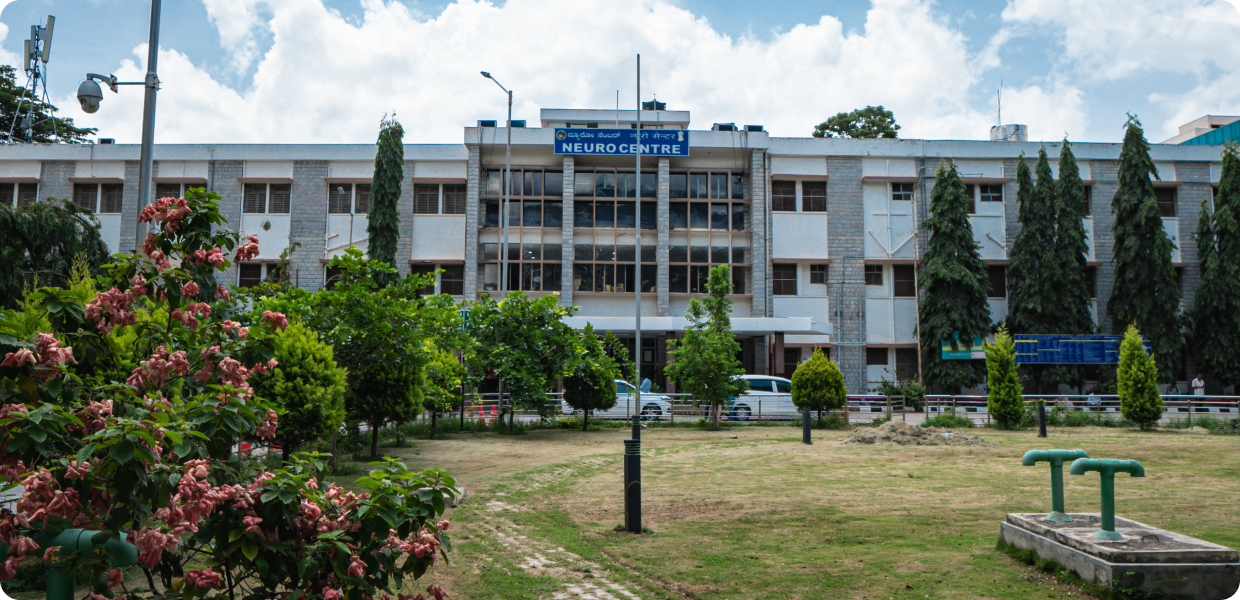
The facilities follow the tripartite mission of care, research and training rather than a conventional college layout. The clinical spine is the 1000-bed NABH-accredited hospital and the 125-bed Sub-Speciality Block for neurology and neurosurgery, backed by round-the-clock emergency and neurosurgical units and a set of operation theatres built for complex cranial work. All the diagnostic laboratories carry NABL accreditation, so the pathology and imaging a resident trains on is externally quality-assured.
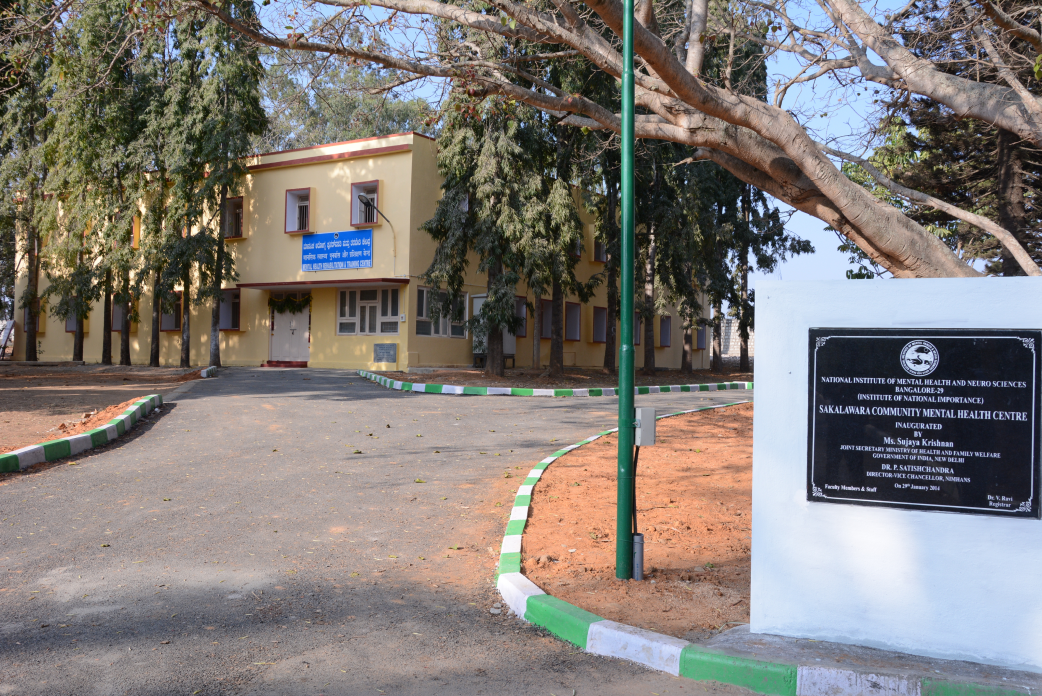
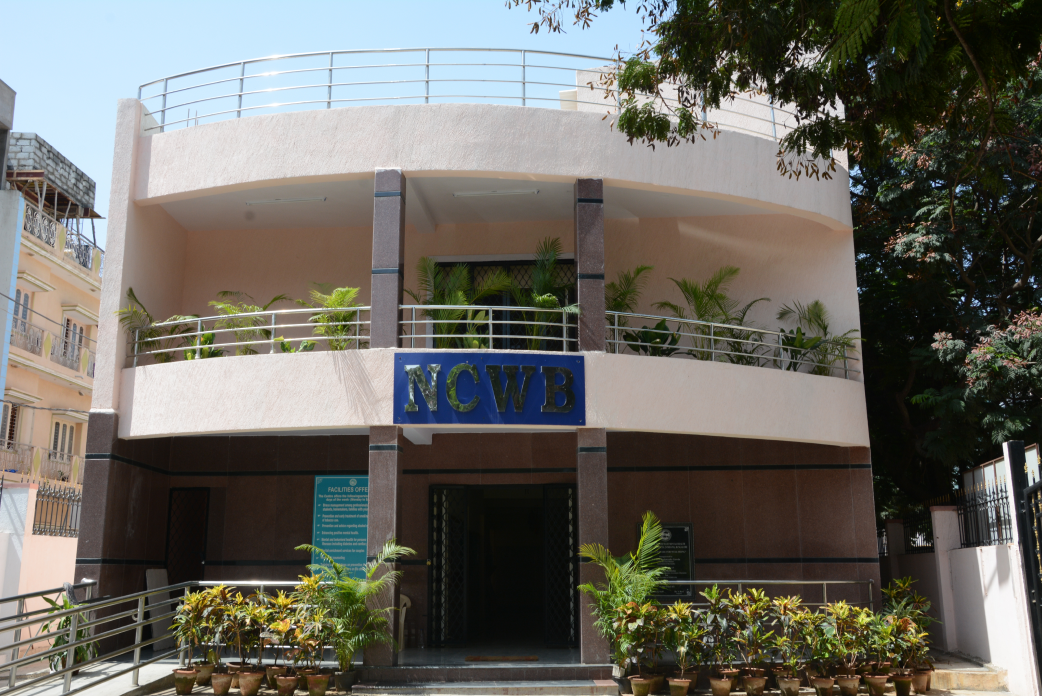
Beyond the wards the institute runs community-facing units that double as teaching sites: the Sakalwara Community Mental Health Centre and the NIMHANS Centre for Well Being in south Bengaluru take the training out of the tertiary hospital and into everyday settings, and a poly-trauma centre is being developed on the Kyalasanahalli land to the north of the city. For a student the value is that the campus offers the whole pathway, from a specialist ward to a community clinic to a research bench, without leaving the institute.
Hostel
Hostel accommodation at NIMHANS is folded into the fee bundle rather than charged as separate rent. The Rs 5,000 taken at admission is a combined caution-money-and-hostel deposit, and a resident then pays a mess charge the prospectus sets at about Rs 3,969 for a thirty-day month; for the stipended INI-CET and INI-SS trainees that mess bill is deducted straight from monthly emoluments, so their board nets against pay instead of arriving as a separate charge. Room allotment for a given session is run by the institute's hostel office.
Faculty
The teaching strength counts for more here than at a general college, because of who it is pointed at. In its NIRF 2025 return NIMHANS entered 255 faculty members, and with no MBBS batch in the building that whole capacity supervises a body that is almost entirely postgraduate and doctoral. Many of the 255 also staff the disease-specific clinics, so a trainee is supervised by consultants carrying a live caseload in the exact sub-field being learned, at a mentor-to-student ratio a mass-intake MBBS college is not built to offer.
The doctoral side is where that shows most clearly: the same return records 280 full-time PhD scholars against 146 students in the MD and MS programmes, so the research cohort actually outnumbers the clinical-residency one, which is unusual and marks where the institute's centre of gravity sits.
Notable Alumni
The most traceable names at NIMHANS are its own pioneers and its past directors, both documented on the institute's history page rather than in an alumni brochure. Foremost among the pioneers is Dr. M.V. Govindaswamy, the medical superintendent whose work, including that first leucotomy, turned the Bengaluru mental hospital into a modern psychiatric and teaching centre, and the same official history sets out the line of directors who have led the institute since the 1974 merger.
The more useful thing to read is the trajectory those names describe: NIMHANS graduates tend to become the heads of psychiatry and neuroscience departments elsewhere, the architects of national mental-health programmes, and senior clinician-researchers in the field. Any specific name is worth checking against that official record before it is repeated.
News & Articles
NIMHANS runs its announcements through an official notice board rather than a press feed, and for an applicant the notices that matter are the admission and entrance-test schedules, the counselling dates for the INI-CET and INI-SS seats, and the recruitment advertisements the institute issues through the year. These are dated to a cycle and change often, so reproducing a specific notice here would age badly within weeks.
The reliable move is to read the current notifications straight from the institute's academics and announcements pages, where the July-session prospectus, the entrance-test calendar and the results are posted as each stage opens. Treat any second-hand date you see elsewhere as provisional until it matches the official notice.
College Compare
The comparison worth making is not NIMHANS against a general medical college, since it does not run the MBBS-to-super-speciality ladder those colleges do, but NIMHANS against the other place you could actually train in your specific field. For psychiatry, clinical psychology, neurology or neurosurgery, the peer set is a short list of national institutes and a few large university departments, and the things that separate them are concrete: the size of the referral caseload you would work in, whether the sub-speciality you want exists as its own department, and whether you enter it by INI-CET and INI-SS or by a separate entrance test.
So run the comparison at the level of the department, not the institute. Line up your target sub-field's seat count, its entry route and its faculty against the equivalent unit elsewhere, and treat each institution's official NIRF standing and published seat list as the evidence rather than a single league-table row. For a general MBBS or a broad multi-speciality campus, NIMHANS is simply not on the shortlist, because it admits neither.
Contact & Location
NIMHANS sits on Hosur Road, on the Marigowda Road side by Lakkasandra and Wilson Garden, at the Bengaluru 560029 postal address, with the hospital wing and the academic wing on either side of the arterial road. The main exchange number is 080-26995000, and specific offices run their own lines: the Registrar's office, which handles academic and admission matters, is on 080-26995005 with the email regt@nimhans.ac.in, and the Dean's office is on 080-26995004 at dean@nimhans.ac.in.
| Contact | Detail |
|---|---|
| Address | Hosur Road, Lakkasandra, Bengaluru 560029, Karnataka |
| Exchange | 080-26995000 |
| Registrar | 080-26995005, regt@nimhans.ac.in |
| Dean | 080-26995004, dean@nimhans.ac.in |
Verified
Approvals & Accreditation
Statutory approvals and accreditation grades from official bodies.
Aid
Scholarships
Decide
Compare with similar colleges
Voices
Student Reviews
Campus
Gallery
Questions
Frequently asked questions
References
Sources
- Official website – nimhans.ac.in
- NIMHANS PG Prospectus 2026-27 – nimhansbkt.demo-appiness.com
- NIRF 2025 ranking – nirfindia.org
At a glance
Quick facts
- Established
- 1974
- NIRF 2025 (Medical)
- Rank #7NIRF· 2025-08-14
- Website
- nimhans.ac.in

Expertie Editorial Team
This page is researched and maintained by the Expertie editorial team, and checked against official sources.
Found something that looks wrong? Email us at editorial@expertie.com.
Last updated